第14章流体力学
Laminar Flow Confined to Tubes: Poiseuille’s Law管内の層流:ポアズイユの法則
What causes flow? The answer, not surprisingly, is a pressure difference. In fact, there is a very simple relationship between horizontal flow and pressure. Flow rate Q is in the direction from high to low pressure. The greater the pressure differential between two points, the greater the flow rate. This relationship can be stated as
英語のヒント
流れを生むものは何か。意外ではないが、答えは圧力差である。実際、水平な流れと圧力の間には非常に単純な関係がある。流量Qで流れる向きは、高圧側から低圧側である。二点間の圧力差が大きいほど、流量も大きい。この関係は次のように表せる。
where and are the pressures at two points, such as at either end of a tube, and R is the resistance to flow. The resistance R includes everything, except pressure, that affects flow rate. For example, R is greater for a long tube than for a short one. The greater the viscosity of a fluid, the greater the value of R. Turbulence greatly increases R, whereas increasing the diameter of a tube decreases R.
英語のヒント
ここでとは、たとえば管の両端のような二点の圧力、Rは流れに対する抵抗である。抵抗Rには、圧力以外で流量に影響するすべての要因が含まれる。たとえば、長い管のRは短い管より大きい。流体の粘性が大きいほど、Rも大きい。乱流はRを大きく増加させるのに対し、管の直径を大きくするとRは減少する。
If viscosity is zero, the fluid is frictionless and the resistance to flow is also zero. Comparing frictionless flow in a tube to viscous flow, as in Figure 14.37, we see that for a viscous fluid, speed is greatest at midstream because of drag at the boundaries. We can see the effect of viscosity in a Bunsen burner flame [part (c)], even though the viscosity of natural gas is small.
英語のヒント
粘性がゼロなら、流体には摩擦がなく、流れへの抵抗もゼロである。図14.37のように管内の摩擦のない流れと粘性のある流れを比べると、粘性流体では境界での抵抗のため、中心の流速が最大となる。天然ガスの粘性は小さいが、ブンゼンバーナーの炎にもその効果が見える[(c)]。
Image omitted because its reuse rights could not be verified.権利の確認ができないため画像を割愛。
Figure 14.37図 14.37
(a) If fluid flow in a tube has negligible resistance, the speed is the same all across the tube. (b) When a viscous fluid flows through a tube, its speed at the walls is zero, increasing steadily to its maximum at the center of the tube. (c) The shape of a Bunsen burner flame is due to the velocity profile across the tube. (credit c: modification of work by "jasonwoodhead23"/Flickr)
英語のヒント
(a) 管内の流れの抵抗が無視できる場合、速さは管の断面全体で同じである。(b) 粘性流体が管内を流れると、壁面での速さはゼロとなり、中心へ向かって連続的に増して最大に達する。(c) ブンゼンバーナーの炎の形は、管の断面にわたる速度分布によって決まる。(クレジットc:“jasonwoodhead23”/Flickrの作品を改変)
The resistance R to laminar flow of an incompressible fluid with viscosity through a horizontal tube of uniform radius r and length l, is given by
英語のヒント
粘性の非圧縮性流体が、半径rが一定で長さlの水平な管を層流として流れるとき、その抵抗Rは次の式で与えられる。
This equation is called Poiseuille’s law for resistance, named after the French scientist J. L. Poiseuille (1799–1869), who derived it in an attempt to understand the flow of blood through the body.
英語のヒント
この式は、抵抗についてのポアズイユの法則と呼ばれる。フランスの科学者J. L. ポアズイユ(1799–1869)が、体内の血流を理解する試みの中で導いたことにちなむ。
Let us examine Poiseuille’s expression for R to see if it makes good intuitive sense. We see that resistance is directly proportional to both fluid viscosity and the length l of a tube. After all, both of these directly affect the amount of friction encountered—the greater either is, the greater the resistance and the smaller the flow. The radius r of a tube affects the resistance, which again makes sense, because the greater the radius, the greater the flow (all other factors remaining the same). But it is surprising that r is raised to the fourth power in Poiseuille’s law. This exponent means that any change in the radius of a tube has a very large effect on resistance. For example, doubling the radius of a tube decreases resistance by a factor of .
英語のヒント
ポアズイユによるRの式が、直感的にも納得できるかを調べよう。抵抗は、流体の粘性と管の長さlの両方に正比例する。どちらも受ける摩擦の大きさに直接影響し、いずれかが大きいほど、抵抗は増し、流量は減る。管の半径rも抵抗に影響する。これも、ほかの要因が同じなら、半径が大きいほど流量が増すことから納得できる。ところが、ポアズイユの法則でrが4乗になることは意外である。この指数は、管の半径の変化が抵抗に非常に大きな影響を与えることを意味する。たとえば、半径を2倍にすると、抵抗は分の1となる。
Taken together, and give the following expression for flow rate:
英語のヒント
とを組み合わせると、流量について次の式が得られる。
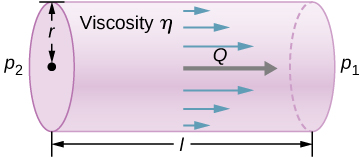
This equation describes laminar flow through a tube. It is sometimes called Poiseuille’s law for laminar flow, or simply Poiseuille’s law (Figure 14.38).
英語のヒント
この式は管内の層流を記述する。層流についてのポアズイユの法則、あるいは単にポアズイユの法則とも呼ばれる(図14.38)。
OpenStax / Rice University, University Physics Volume 1, CC BY 4.0. Source-book artwork retained. · CC BY 4.0 · Source出典

Figure 14.38図 14.38
Poiseuille’s law applies to laminar flow of an incompressible fluid of viscosity through a tube of length l and radius r. The direction of flow is from greater to lower pressure. Flow rate Q is directly proportional to the pressure difference , and inversely proportional to the length l of the tube and viscosity of the fluid. Flow rate increases with radius by a factor of .
英語のヒント
ポアズイユの法則は、粘性の非圧縮性流体が、長さl、半径rの管を層流として流れる場合に適用される。流れは高圧側から低圧側へ向かう。流量Qは圧力差に正比例し、管の長さlと流体の粘性に反比例する。半径による流量の増加はに比例する。
Example 14.8例題 14.8
Using Flow Rate: Air Conditioning Systems流量の活用:空調システム
An air conditioning system is being designed to supply air at a gauge pressure of 0.054 Pa at a temperature of The air is sent through an insulated, round conduit with a diameter of 18.00 cm. The conduit is 20-meters long and is open to a room at atmospheric pressure 101.30 kPa. The room has a length of 12 meters, a width of 6 meters, and a height of 3 meters. (a) What is the volume flow rate through the pipe, assuming laminar flow? (b) Estimate the length of time to completely replace the air in the room. (c) The builders decide to save money by using a conduit with a diameter of 9.00 cm. What is the new flow rate?
英語のヒント
ゲージ圧0.054 Pa、温度で空気を供給する空調システムを設計している。空気は、直径18.00 cmの断熱された丸いダクトを通る。ダクトの長さは20 mで、大気圧101.30 kPaの部屋に開いている。部屋は長さ12 m、幅6 m、高さ3 mである。(a) 層流を仮定すると、管を通る体積流量はいくらか。(b) 部屋の空気をすべて入れ替えるのに要する時間を見積もれ。(c) 施工者は費用を抑えるため、直径9.00 cmのダクトを使うことにした。新しい流量はいくらか。
Strategy方針
Assuming laminar flow, Poiseuille’s law states that
英語のヒント
層流を仮定すると、ポアズイユの法則は次のようになる。
We need to compare the conduit radius before and after the flow rate reduction. Note that we are given the diameter of the conduit, so we must divide by two to get the radius.
英語のヒント
流量を減らす前後のダクトの半径を比較する必要がある。与えられているのはダクトの直径なので、半径を得るには2で割らなければならない。
Solution解答
- Assuming a constant pressure difference and using the viscosity ,
英語のヒント
圧力差が一定と仮定し、粘性を使う。 - Assuming constant flow
英語のヒント
流量が一定であると仮定すると、である。 - Using laminar flow, Poiseuille’s law yields
英語のヒント
層流として、ポアズイユの法則から次の式を得る。Thus, the radius of the conduit decreases by half reduces the flow rate to 6.25% of the original value.英語のヒント
したがって、ダクトの半径を半分にすると、流量は元の値の6.25%まで減る。
Significance考察
In general, assuming laminar flow, decreasing the radius has a more dramatic effect than changing the length. If the length is increased and all other variables remain constant, the flow rate is decreased:
英語のヒント
一般に、層流を仮定した場合、半径を小さくする効果は、長さを変える効果よりはるかに大きい。ほかの変数を一定に保って長さを増すと、流量は次のように減少する。
Doubling the length cuts the flow rate to one-half the original flow rate.
英語のヒント
長さを2倍にすると、流量は元の半分になる。
If the radius is decreased and all other variables remain constant, the volume flow rate decreases by a much larger factor.
英語のヒント
ほかの変数を一定に保って半径を小さくすると、体積流量はさらに大きな割合で減少する。
Cutting the radius in half decreases the flow rate to one-sixteenth the original flow rate.
英語のヒント
半径を半分にすると、流量は元の16分の1になる。