第14章流体力学
14.6 Bernoulli’s Equation14.6 ベルヌーイの式
Learning Objectives学習目標
Learning Objectives学習目標
By the end of this section, you will be able to:
英語のヒント
この節を終えると、次のことができるようになる。
- Explain the terms in Bernoulli’s equation
英語のヒント
ベルヌーイの式に含まれる各項を説明する。 - Explain how Bernoulli’s equation is related to the conservation of energy
英語のヒント
ベルヌーイの式とエネルギー保存との関係を説明する。 - Describe how to derive Bernoulli’s principle from Bernoulli’s equation
英語のヒント
ベルヌーイの式からベルヌーイの原理を導く方法を説明する。 - Perform calculations using Bernoulli’s principle
英語のヒント
ベルヌーイの原理を使って計算する。 - Describe some applications of Bernoulli’s principle
英語のヒント
ベルヌーイの原理の応用例を説明する。
As we showed in Figure 14.27, when a fluid flows into a narrower channel, its speed increases. That means its kinetic energy also increases. The increased kinetic energy comes from the net work done on the fluid to push it into the channel. Also, if the fluid changes vertical position, work is done on the fluid by the gravitational force.
英語のヒント
図14.27で示したように、流体が細い流路へ入ると、速さが増す。このため運動エネルギーも増加する。その増加分は、流体を流路へ押し込む際に加えられた正味の仕事から来る。また、流体が鉛直方向へ移動すれば、重力も流体に仕事をする。
A pressure difference occurs when the channel narrows. This pressure difference results in a net force on the fluid because the pressure times the area equals the force, and this net force does work. Recall the work-energy theorem,
英語のヒント
流路が狭くなると圧力差が生じる。圧力と面積の積は力に等しいため、この圧力差から流体への合力が生じ、合力が仕事をする。仕事とエネルギーの定理を思い出そう。
The net work done increases the fluid’s kinetic energy. As a result, the pressure drops in a rapidly moving fluid whether or not the fluid is confined to a tube.
英語のヒント
加えられた正味の仕事は、流体の運動エネルギーを増やす。その結果、流体が管内に閉じ込められているかどうかによらず、速く動く流体では圧力が低下する。
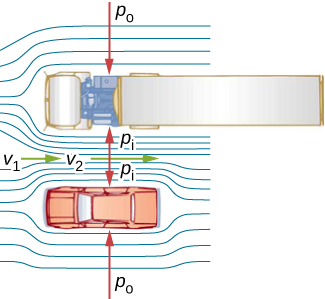
There are many common examples of pressure dropping in rapidly moving fluids. For instance, shower curtains have a disagreeable habit of bulging into the shower stall when the shower is on. The reason is that the high-velocity stream of water and air creates a region of lower pressure inside the shower, whereas the pressure on the other side remains at the standard atmospheric pressure. This pressure difference results in a net force, pushing the curtain inward. Similarly, when a car passes a truck on the highway, the two vehicles seem to pull toward each other. The reason is the same: The high velocity of the air between the car and the truck creates a region of lower pressure between the vehicles, and they are pushed together by greater pressure on the outside (Figure 14.29). This effect was observed as far back as the mid-1800s, when it was found that trains passing in opposite directions tipped precariously toward one another.
英語のヒント
速く動く流体で圧力が下がる例は身近に多い。例えば、シャワーを出すとカーテンが内側へ膨らむという、困ったことが起こる。高速の水と空気の流れがシャワー内部の圧力を下げる一方、外側は通常の大気圧のままだからである。圧力差によって、カーテンを内側へ押す合力が生じる。同様に、高速道路で乗用車がトラックを追い越すと、両者は互いに引き合うように見える。理由は同じである。車とトラックの間を速い空気が流れ、そこで圧力が低くなるため、外側の高い圧力が二台を押し寄せる(図14.29)。この効果は19世紀半ばにはすでに観察されており、反対方向へ走る列車がすれ違うと、互いの側へ危険なほど傾くことが分かっていた。
OpenStax / Rice University, University Physics Volume 1, CC BY 4.0. Source-book artwork retained. · CC BY 4.0 · Source出典

Figure 14.29図 14.29
An overhead view of a car passing a truck on a highway. Air passing between the vehicles flows in a narrower channel and must increase its speed ( is greater than ), causing the pressure between them to drop ( is less than Greater pressure on the outside pushes the car and truck together.
英語のヒント
高速道路で乗用車がトラックを追い越す様子を上から見た図。二台の間の空気は、流路が狭くなるため速さを増す(はより大きい)。その結果、二台の間の圧力は下がる(はより小さい)。外側の大きな圧力が、乗用車とトラックを互いに近づける。
Energy Conservation and Bernoulli’s Equationエネルギー保存とベルヌーイの式
The application of the principle of conservation of energy to frictionless laminar flow leads to a very useful relation between pressure and flow speed in a fluid. This relation is called Bernoulli’s equation, named after Daniel Bernoulli (1700–1782), who published his studies on fluid motion in his book Hydrodynamica (1738).
英語のヒント
摩擦のない層流にエネルギー保存の原理を適用すると、流体の圧力と流速について非常に有用な関係が得られる。これをベルヌーイの式という。『流体力学』(1738年)で流体運動の研究を発表したダニエル・ベルヌーイ(1700–1782)にちなんでいる。
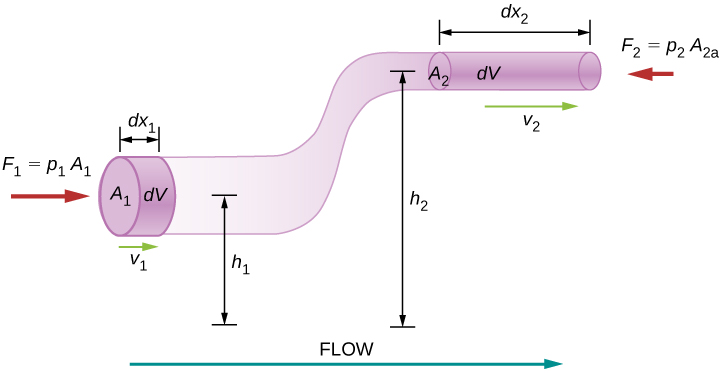
Consider an incompressible fluid flowing through a pipe that has a varying diameter and height, as shown in Figure 14.30. Subscripts 1 and 2 in the figure denote two locations along the pipe and illustrate the relationships between the areas of the cross sections A, the speed of flow v, the height from ground h, and the pressure p at each point. We assume here that the density at the two points is the same—therefore, density is denoted by without any subscripts—and since the fluid is incompressible, the shaded volumes must be equal.
英語のヒント
図14.30のように、直径と高さが変わる管を流れる非圧縮性流体を考えよう。添字1と2は管に沿った二つの位置を示し、それぞれの断面積A、流速v、地面からの高さh、圧力pの関係を表す。ここでは二点の密度は同じと仮定するので、密度は添字なしので表す。また、流体は非圧縮性なので、薄色で示した二つの体積は等しくなければならない。
OpenStax / Rice University, University Physics Volume 1, CC BY 4.0. Source-book artwork retained. · CC BY 4.0 · Source出典

Figure 14.30図 14.30
The geometry used for the derivation of Bernoulli’s equation.
英語のヒント
ベルヌーイの式の導出に使う幾何学的な配置。
We also assume that there are no viscous forces in the fluid, so the energy of any part of the fluid will be conserved. To derive Bernoulli’s equation, we first calculate the work that was done on the fluid:
英語のヒント
流体には粘性力が働かず、そのどの部分のエネルギーも保存されると仮定する。ベルヌーイの式を導くため、まず流体に加えられた仕事を計算する。
The work done was due to the conservative force of gravity and the change in the kinetic energy of the fluid. The change in the kinetic energy of the fluid is equal to
英語のヒント
加えられた仕事は、保存力である重力による仕事と、流体の運動エネルギーの変化に対応する。運動エネルギーの変化は、次のようになる。
The change in potential energy is
英語のヒント
位置エネルギーの変化は、次のとおりである。
The energy equation then becomes
英語のヒント
したがって、エネルギーの式は次のようになる。
Rearranging the equation gives Bernoulli’s equation:
英語のヒント
整理すると、ベルヌーイの式が得られる。
This relation states that the mechanical energy of any part of the fluid changes as a result of the work done by the fluid external to that part, due to varying pressure along the way. Since the two points were chosen arbitrarily, we can write Bernoulli’s equation more generally as a conservation principle along the flow.
英語のヒント
この関係は、流体のある部分の力学的エネルギーが、経路に沿って変わる圧力のために、その外側の流体から加えられる仕事によって変化することを述べる。二点は任意に選んだので、ベルヌーイの式は、流れに沿った保存原理として、より一般的に書ける。
A special note must be made here of the fact that in a dynamic situation, the pressures at the same height in different parts of the fluid may be different if they have different speeds of flow.
英語のヒント
ここで特に注意すべきことがある。動いている流体では、高さが同じでも、部分ごとに流速が違えば、圧力も異なり得る。