第14章流体力学
Manometers液柱圧力計
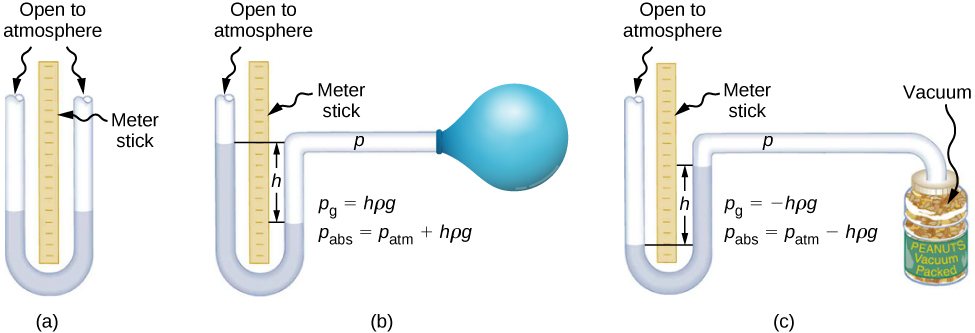
One of the most important classes of pressure gauges applies the property that pressure due to the weight of a fluid of constant density is given by . The U-shaped tube shown in Figure 14.12 is an example of a manometer; in part (a), both sides of the tube are open to the atmosphere, allowing atmospheric pressure to push down on each side equally so that its effects cancel.
英語のヒント
圧力計の重要な一群は、密度が一定の流体の重さによる圧力がで与えられるという性質を利用する。図14.12のU字管は、液柱圧力計の一例である。(a)では管の両側が大気に開かれており、大気圧が両側を等しく押し下げるため、その効果は打ち消し合う。
A manometer with only one side open to the atmosphere is an ideal device for measuring gauge pressures. The gauge pressure is and is found by measuring h. For example, suppose one side of the U-tube is connected to some source of pressure such as the balloon in part (b) of the figure or the vacuum-packed peanut jar shown in part (c). Pressure is transmitted undiminished to the manometer, and the fluid levels are no longer equal. In part (b), is greater than atmospheric pressure, whereas in part (c), is less than atmospheric pressure. In both cases, differs from atmospheric pressure by an amount where is the density of the fluid in the manometer. In part (b), can support a column of fluid of height h, so it must exert a pressure greater than atmospheric pressure (the gauge pressure is positive). In part (c), atmospheric pressure can support a column of fluid of height h, so is less than atmospheric pressure by an amount (the gauge pressure is negative).
英語のヒント
片側だけを大気へ開いた液柱圧力計は、ゲージ圧を測るのに適している。ゲージ圧はであり、hを測れば求められる。例えばU字管の一方を、図(b)の風船や(c)の真空包装のピーナッツ瓶のような、圧力の源へつなぐとする。圧力は弱まらずに圧力計へ伝わり、液面の高さは等しくなくなる。(b)ではが大気圧より高く、(c)ではが大気圧より低い。どちらもと大気圧との差はである。は圧力計内の流体の密度である。(b)ではが高さhの液柱を支えられるので、大気圧よりだけ高い圧力を及ぼす必要がある。ゲージ圧は正となる。(c)では大気圧が高さhの液柱を支えるので、は大気圧よりだけ低い。ゲージ圧は負となる。
OpenStax / Rice University, University Physics Volume 1, CC BY 4.0. Source-book artwork retained. · CC BY 4.0 · Source出典

Figure 14.12図 14.12
An open-tube manometer has one side open to the atmosphere. (a) Fluid depth must be the same on both sides, or the pressure each side exerts at the bottom will be unequal and liquid will flow from the deeper side. (b) A positive gauge pressure transmitted to one side of the manometer can support a column of fluid of height h. (c) Similarly, atmospheric pressure is greater than a negative gauge pressure by an amount . The jar’s rigidity prevents atmospheric pressure from being transmitted to the peanuts.
英語のヒント
開管式の液柱圧力計は、一方を大気へ開いてある。(a) 両側の液面の高さは等しくなければならない。等しくなければ底での圧力に差が生じ、深い側から液体が流れる。(b) 正のゲージ圧を片側へ伝えると、高さhの液柱を支えられる。(c) 同様に、負のゲージ圧を示す側に対しては、大気圧がだけ大きい。瓶が硬いため、大気圧はピーナッツへそのまま伝わらない。
Barometers気圧計
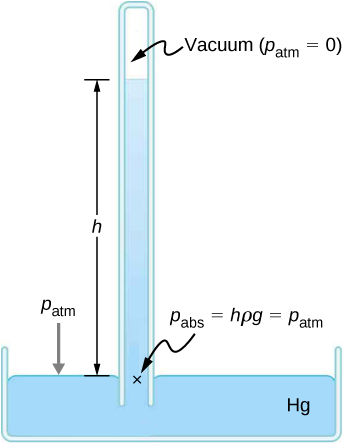
Manometers typically use a U-shaped tube of a fluid (often mercury) to measure pressure. A barometer (see Figure 14.13) is a device that typically uses a single column of mercury to measure atmospheric pressure. The barometer, invented by the Italian mathematician and physicist Evangelista Torricelli (1608–1647) in 1643, is constructed from a glass tube closed at one end and filled with mercury. The tube is then inverted and placed in a pool of mercury. This device measures atmospheric pressure, rather than gauge pressure, because there is a nearly pure vacuum above the mercury in the tube. The height of the mercury is such that . When atmospheric pressure varies, the mercury rises or falls.
英語のヒント
液柱圧力計は通常、流体(多くは水銀)を入れたU字管で圧力を測る。気圧計(図14.13)は、一般に1本の水銀柱を使って大気圧を測る装置である。イタリアの数学者・物理学者エヴァンジェリスタ・トリチェリ(1608–1647)が1643年に発明した気圧計は、一端を閉じたガラス管を水銀で満たして作る。この管を逆さまにして、水銀のたまった容器へ差し込む。管内の水銀の上はほぼ完全な真空なので、この装置はゲージ圧ではなく大気圧を測る。水銀柱の高さはとなる高さである。大気圧が変わると、水銀柱は上がったり下がったりする。
Weather forecasters closely monitor changes in atmospheric pressure (often reported as barometric pressure), as rising mercury typically signals improving weather and falling mercury indicates deteriorating weather. The barometer can also be used as an altimeter, since average atmospheric pressure varies with altitude. Mercury barometers and manometers are so common that units of mm Hg are often quoted for atmospheric pressure and blood pressures.
英語のヒント
天気予報では、大気圧(気圧計の圧力として示されることが多い)の変化を注意深く監視する。水銀柱の上昇は一般に天候の回復を、下降は悪化を示すためである。平均の大気圧は高度によって変わるので、気圧計は高度計としても使える。水銀気圧計と液柱圧力計は非常に広く使われているため、大気圧や血圧にはmm Hgという単位もよく使われる。
OpenStax / Rice University, University Physics Volume 1, CC BY 4.0. Source-book artwork retained. · CC BY 4.0 · Source出典

Figure 14.13図 14.13
A mercury barometer measures atmospheric pressure. The pressure due to the mercury’s weight, , equals atmospheric pressure. The atmosphere is able to force mercury in the tube to a height h because the pressure above the mercury is zero.
英語のヒント
水銀気圧計は大気圧を測る。水銀の重さによる圧力は、大気圧に等しい。水銀の上の圧力がゼロであるため、大気は管内の水銀を高さhまで押し上げられる。
Example 14.2例題 14.2
Fluid Heights in an Open U-Tube両端が開いたU字管の液面の高さ
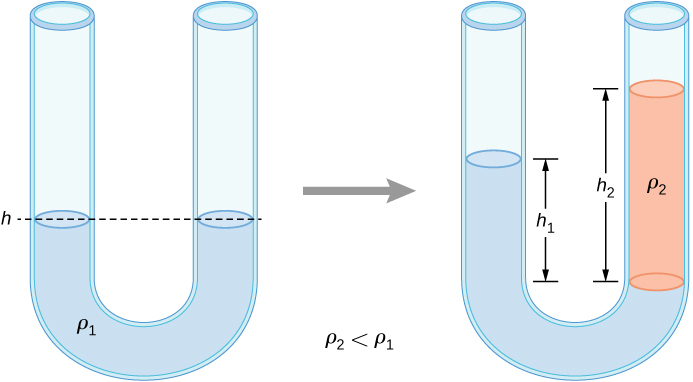
A U-tube with both ends open is filled with a liquid of density to a height h on both sides (Figure 14.14). A liquid of density is poured into one side and Liquid 2 settles on top of Liquid 1. The heights on the two sides are different. The height to the top of Liquid 2 from the interface is and the height to the top of Liquid 1 from the level of the interface is . Derive a formula for the height difference.
英語のヒント
両端を開いたU字管へ、密度の液体を入れると、両側の高さはhになる(図14.14)。片側へ密度の液体を注ぎ、液体2が液体1の上に重なったとする。両側の液面の高さは異なる。境界面から液体2の上面までの高さは、同じ境界面の高さから液体1の上面まではである。液面の高さの差を表す式を導け。
OpenStax / Rice University, University Physics Volume 1, CC BY 4.0. Source-book artwork retained. · CC BY 4.0 · Source出典

Figure 14.14図 14.14
Two liquids of different densities are shown in a U-tube.
英語のヒント
密度の異なる二つの液体がU字管に入っている。
Strategy方針
The pressure at points at the same height on the two sides of a U-tube must be the same as long as the two points are in the same liquid. Therefore, we consider two points at the same level in the two arms of the tube: One point is the interface on the side of the Liquid 2 and the other is a point in the arm with Liquid 1 that is at the same level as the interface in the other arm. The pressure at each point is due to atmospheric pressure plus the weight of the liquid above it.
英語のヒント
U字管の両側で同じ高さにある点の圧力は、二つの点が同じ液体内にある限り等しくなければならない。そこで、管の両枝で同じ高さの二点を考える。一方は液体2側の境界面、他方は液体1側で、その境界面と同じ高さの点である。各点の圧力は、大気圧と、その上にある液体の重さによる圧力の和である。
Solution解答
Since the two points are in Liquid 1 and are at the same height, the pressure at the two points must be the same. Therefore, we have
英語のヒント
二点はどちらも液体1の中にあり、高さも同じなので、その圧力は等しくなければならない。したがって、
Hence,
英語のヒント
したがって、
This means that the difference in heights on the two sides of the U-tube is
英語のヒント
このことから、U字管の両側の高さの差は次のようになる。
The result makes sense if we set which gives If the two sides have the same density, they have the same height.
英語のヒント
とおくととなることから、この結果が妥当だと分かる。両側の密度が同じなら、高さも同じになる。