第14章流体力学
14.7 Viscosity and Turbulence14.7 粘性と乱流
Learning Objectives学習目標
Learning Objectives学習目標
By the end of this section, you will be able to:
英語のヒント
この節を終えると、次のことができるようになる。
- Explain what viscosity is
英語のヒント
粘性とは何かを説明する。 - Calculate flow and resistance with Poiseuille's law
英語のヒント
ポアズイユの法則で流量と抵抗を計算する。 - Explain how pressure drops due to resistance
英語のヒント
抵抗によって圧力が下がる仕組みを説明する。 - Calculate the Reynolds number for an object moving through a fluid
英語のヒント
流体中を動く物体のレイノルズ数を計算する。 - Use the Reynolds number for a system to determine whether it is laminar or turbulent
英語のヒント
系のレイノルズ数を使い、層流か乱流かを判定する。 - Describe the conditions under which an object has a terminal speed
英語のヒント
物体が終端の速さになる条件を説明する。
In Applications of Newton’s Laws, which introduced the concept of friction, we saw that an object sliding across the floor with an initial velocity and no applied force comes to rest due to the force of friction. Friction depends on the types of materials in contact and is proportional to the normal force. We also discussed drag and air resistance in that same chapter. We explained that at low speeds, the drag is proportional to the velocity, whereas at high speeds, drag is proportional to the velocity squared. In this section, we introduce the forces of friction that act on fluids in motion. For example, a fluid flowing through a pipe is subject to resistance, a type of friction, between the fluid and the walls. Friction also occurs between the different layers of fluid. These resistive forces affect the way the fluid flows through the pipe.
英語のヒント
摩擦の概念を導入した「ニュートンの法則の応用」では、初速度を与えて床の上を滑らせた物体が、その後に力を加えなくても、摩擦力によって静止することを見た。摩擦は接触する物質の種類に依存し、垂直抗力に比例する。同じ章では、抗力と空気抵抗も扱った。低速では抗力が速度に比例し、高速では速度の2乗に比例することを説明した。この節では、動く流体に働く摩擦力を導入する。たとえば、管内を流れる流体は、流体と管壁との間に生じる摩擦の一種である抵抗を受ける。流体の異なる層の間にも摩擦が生じる。こうした抵抗力は、管内の流れ方に影響する。
Viscosity and Laminar Flow粘性と層流
When you pour yourself a glass of juice, the liquid flows freely and quickly. But if you pour maple syrup on your pancakes, that liquid flows slowly and sticks to the pitcher. The difference is fluid friction, both within the fluid itself and between the fluid and its surroundings. We call this property of fluids viscosity. Juice has low viscosity, whereas syrup has high viscosity.
英語のヒント
コップにジュースを注ぐと、液体はさらさらと速く流れる。パンケーキにメープルシロップを注ぐと、ゆっくり流れ、容器にもまとわりつく。この違いは、流体の内部、および流体と周囲との間に働く摩擦による。この流体の性質を粘性と呼ぶ。ジュースの粘性は小さく、シロップの粘性は大きい。
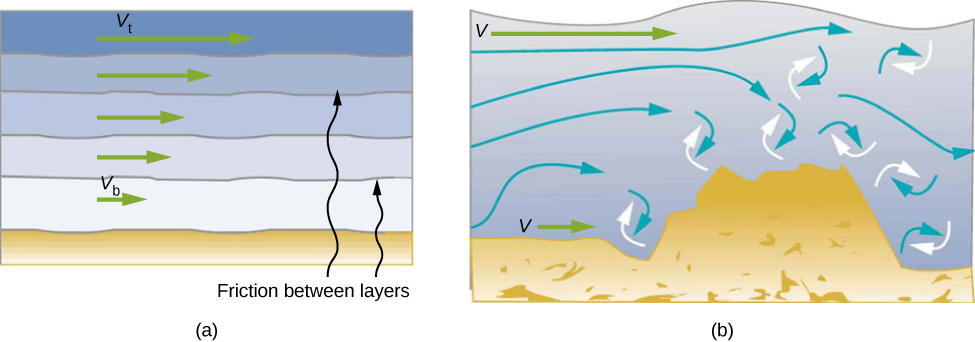
The precise definition of viscosity is based on laminar, or nonturbulent, flow. Figure 14.34 shows schematically how laminar and turbulent flow differ. When flow is laminar, layers flow without mixing. When flow is turbulent, the layers mix, and significant velocities occur in directions other than the overall direction of flow.
英語のヒント
粘性の厳密な定義は、層流、すなわち乱れていない流れに基づく。図14.34は層流と乱流の違いを模式的に示す。層流では、各層が混ざらずに流れる。乱流では各層が混ざり、全体の流れの方向以外にも大きな速度が生じる。
OpenStax / Rice University, University Physics Volume 1, CC BY 4.0. Source-book artwork retained. · CC BY 4.0 · Source出典

Figure 14.34図 14.34
(a) Laminar flow occurs in layers without mixing. Notice that viscosity causes drag between layers as well as with the fixed surface. The speed near the bottom of the flow () is less than speed near the top () because in this case, the surface of the containing vessel is at the bottom. (b) An obstruction in the vessel causes turbulent flow. Turbulent flow mixes the fluid. There is more interaction, greater heating, and more resistance than in laminar flow.
英語のヒント
(a) 層流では、層どうしが混ざらずに流れる。粘性により、層の間だけでなく固定面との間にも抵抗が生じる。この場合、容器の表面は流れの底にあるため、底付近の速さ()は上部の速さ()より小さい。(b) 容器内の障害物が乱流を生む。乱流は流体を混ぜる。層流より相互作用、発熱、抵抗が大きくなる。
Turbulence is a fluid flow in which layers mix together via eddies and swirls. It has two main causes. First, any obstruction or sharp corner, such as in a faucet, creates turbulence by imparting velocities perpendicular to the flow. Second, high speeds cause turbulence. The drag between adjacent layers of fluid and between the fluid and its surroundings can form swirls and eddies if the speed is great enough. In Figure 14.35, the speed of the accelerating smoke reaches the point that it begins to swirl due to the drag between the smoke and the surrounding air.
英語のヒント
乱流とは、渦によって各層が混ざり合う流れである。主な原因は二つある。第一に、蛇口などの障害物や急な曲がりが、流れに垂直な速度を与えて乱流を生じさせる。第二に、高速でも乱流が生じる。速さが十分大きいと、隣接する層の間、および流体と周囲との間の抵抗によって渦ができる。図14.35では、加速する煙の速さが、周囲の空気との抵抗によって渦を巻き始める値に達している。
Image omitted because its reuse rights could not be verified.権利の確認ができないため画像を割愛。
Figure 14.35図 14.35
Smoke rises smoothly for a while and then begins to form swirls and eddies. The smooth flow is called laminar flow, whereas the swirls and eddies typify turbulent flow. Smoke rises more rapidly when flowing smoothly than after it becomes turbulent, suggesting that turbulence poses more resistance to flow. (credit: “Creativity103”/Flickr)
英語のヒント
煙はしばらく滑らかに上昇し、その後、渦を作り始める。滑らかな流れを層流と呼び、渦は乱流の典型的な特徴である。煙は乱れた後よりも滑らかに流れている間のほうが速く上昇する。このことは、乱流では流れへの抵抗が増すことを示唆する。(クレジット:“Creativity103”/Flickr)
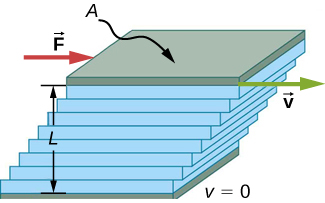
Figure 14.36 shows how viscosity is measured for a fluid. The fluid to be measured is placed between two parallel plates. The bottom plate is held fixed, while the top plate is moved to the right, dragging fluid with it. The layer (or lamina) of fluid in contact with either plate does not move relative to the plate, so the top layer moves at speed v while the bottom layer remains at rest. Each successive layer from the top down exerts a force on the one below it, trying to drag it along, producing a continuous variation in speed from v to 0 as shown. Care is taken to ensure that the flow is laminar, that is, the layers do not mix. The motion in the figure is like a continuous shearing motion. Fluids have zero shear strength, but the rate at which they are sheared is related to the same geometrical factors A and L as is shear deformation for solids. In the diagram, the fluid is initially at rest. The layer of fluid in contact with the moving plate is accelerated and starts to move due to the internal friction between moving plate and the fluid. The next layer is in contact with the moving layer; since there is internal friction between the two layers, it also accelerates, and so on through the depth of the fluid. There is also internal friction between the stationary plate and the lowest layer of fluid, next to the station plate. The force is required to keep the plate moving at a constant velocity due to the internal friction.
英語のヒント
図14.36は流体の粘性の測定法を示す。測る流体を平行な2枚の板の間に置く。下の板を固定し、上の板を右へ動かすと、流体も引きずられる。いずれの板に接する流体の層も、その板に対しては動かない。そのため、最上層は速さvで動き、最下層は静止したままである。上から順に、各層はその下の層を引きずろうとして力を加えるので、図のように速さはvから0まで連続的に変化する。各層が混ざらない層流になるように注意する。図の運動は、連続的なせん断運動に似ている。流体のせん断強度はゼロだが、せん断される速さは、固体のせん断変形の場合と同じ幾何学的要因AとLに関係する。図では、流体は初め静止している。動く板に接した流体の層は、板と流体の内部摩擦によって加速し、動き始める。その次の層は動いている層に接しており、二つの層の間にも内部摩擦があるため、やはり加速する。この作用が流体の深さ方向に順次伝わる。静止した板と、それに接する流体の最下層の間にも内部摩擦がある。この内部摩擦のため、板を一定速度で動かし続けるには力が必要となる。
OpenStax / Rice University, University Physics Volume 1, CC BY 4.0. Source-book artwork retained. · CC BY 4.0 · Source出典

Figure 14.36図 14.36
Measurement of viscosity for laminar flow of fluid between two plates of area A. The bottom plate is fixed. When the top plate is pushed to the right, it drags the fluid along with it.
英語のヒント
面積Aの2枚の板の間の層流を用いた粘性の測定。下の板は固定されている。上の板を右へ押すと、流体も引きずられる。
A force F is required to keep the top plate in Figure 14.36 moving at a constant velocity v, and experiments have shown that this force depends on four factors. First, F is directly proportional to v (until the speed is so high that turbulence occurs—then a much larger force is needed, and it has a more complicated dependence on v). Second, F is proportional to the area A of the plate. This relationship seems reasonable, since A is directly proportional to the amount of fluid being moved. Third, F is inversely proportional to the distance between the plates L. This relationship is also reasonable; L is like a lever arm, and the greater the lever arm, the less the force that is needed. Fourth, F is directly proportional to the coefficient of viscosity, . The greater the viscosity, the greater the force required. These dependencies are combined into the equation
英語のヒント
図14.36の上の板を一定速度vで動かし続けるには力Fが必要であり、実験によると、その力は四つの要因に依存する。第一に、Fはvに正比例する。ただし、速さが大きくなって乱流が起こるまでであり、乱流になると、はるかに大きな力が必要となって、vへの依存も複雑になる。第二に、Fは板の面積Aに比例する。Aは動かされる流体の量に正比例するので、この関係はもっともらしい。第三に、Fは板の間隔Lに反比例する。これも妥当である。Lはてこの腕に似ていて、腕が長いほど必要な力は小さい。第四に、Fは粘性係数に正比例する。粘性が大きいほど、必要な力も大きい。これらの依存関係をまとめると、次の式になる。
This equation gives us a working definition of fluid viscosity . Solving for gives
英語のヒント
この式は、流体の粘性を実際に測るための定義を与える。について解くと、次のようになる。
which defines viscosity in terms of how it is measured.
英語のヒント
これによって、測定方法に基づいて粘性が定義される。
The SI unit of viscosity is . Table 14.4 lists the coefficients of viscosity for various fluids. Viscosity varies from one fluid to another by several orders of magnitude. As you might expect, the viscosities of gases are much less than those of liquids, and these viscosities often depend on temperature.
英語のヒント
粘性のSI単位はである。表14.4に、さまざまな流体の粘性係数を示す。粘性は流体によって何桁も異なる。予想できるように、気体の粘性は液体よりはるかに小さく、多くの場合、粘性は温度にも依存する。
Fluid 流体 |
Temperature 温度 |
Viscosity Pa ⋅ s 粘性 |
|---|---|---|
Air 空気 |
0 |
0.0171 |
20 |
0.0181 |
|
40 |
0.0190 |
|
100 |
0.0218 |
|
Ammonia アンモニア |
20 |
0.00974 |
Carbon dioxide 二酸化炭素 |
20 |
0.0147 |
Helium ヘリウム |
20 |
0.0196 |
Hydrogen 水素 |
0 |
0.0090 |
Mercury 水銀 |
20 |
0.0450 |
Oxygen 酸素 |
20 |
0.0203 |
Steam 水蒸気 |
100 |
0.0130 |
Liquid water 液体の水 |
0 |
1.792 |
20 |
1.002 |
|
37 |
0.6947 |
|
40 |
0.653 |
|
100 |
0.282 |
|
Whole blood 全血 |
20 |
3.015 |
37 |
2.084 |
|
Blood plasma 血漿 |
20 |
1.810 |
37 |
1.257 |
|
Ethyl alcohol エチルアルコール |
20 |
1.20 |
Methanol メタノール |
20 |
0.584 |
Oil (heavy machine) 油(重機械用) |
20 |
660 |
Oil (motor, SAE 10) 油(エンジン用、SAE 10) |
30 |
200 |
Oil (olive) 油(オリーブ油) |
20 |
138 |
Glycerin グリセリン |
20 |
1500 |
Honey 蜂蜜 |
20 |
2000–10000 |
Maple syrup メープルシロップ |
20 |
2000–3000 |
Milk 牛乳 |
20 |
3.0 |
Oil (corn) 油(コーン油) |
20 |
65 |