第2章一次方程式と不等式を解く
Solve Equations That Require Simplification式の整理が必要な方程式を解く
In the previous examples, we were able to isolate the variable with just one operation. Most of the equations we encounter in algebra will take more steps to solve. Usually, we will need to simplify one or both sides of an equation before using the Subtraction or Addition Properties of Equality.
英語のヒント
これまでの例題では、1回の操作で変数だけにできた。代数で扱う方程式の多くは、解くのにさらに多くの手順を要する。通常は、等式の減法や加法の性質を使う前に、方程式の一方または両方の辺を簡単にする必要がある。
You should always simplify as much as possible before you try to isolate the variable. Remember that to simplify an expression means to do all the operations in the expression. Simplify one side of the equation at a time. Note that simplification is different from the process used to solve an equation in which we apply an operation to both sides.
英語のヒント
変数だけにしようとする前に、必ず式をできるだけ簡単にする。式を簡単にするとは、式の中の計算をすべて行うことだった。方程式の一方の辺ずつを簡単にする。これは、両辺に同じ操作を行って方程式を解く過程とは異なることに注意する。
Example 2.6例題 2.6
How to Solve Equations That Require Simplification式の整理が必要な方程式の解き方
Solve:
英語のヒント
次の方程式を解く:
Solution解答
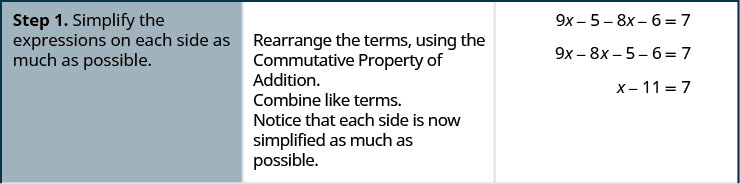


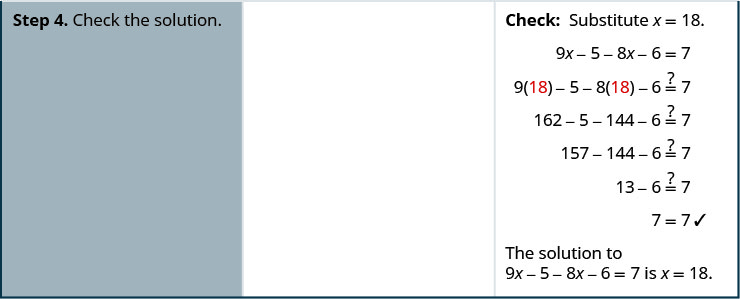
Try It (2)確認問題(2題)
Example 2.7例題 2.7
Solve:
英語のヒント
次の方程式を解く:
Solution解答
We simplify both sides of the equation as much as possible before we try to isolate the variable.
英語のヒント
変数だけにしようとする前に、方程式の両辺をできるだけ簡単にする。
 |
|
Distribute on the left. 左辺で分配法則を使う。 |
 |
Use the Commutative Property to rearrange terms. 交換法則を使って項を並べ替える。 |
 |
Combine like terms. 同類項をまとめる。 |
 |
Each side is as simplified as possible. Next, isolate . 各辺はできるだけ簡単になっている。次にだけにする。 |
|
Undo subtraction by using the Addition Property of Equality. 等式の加法の性質を使い、減法を元に戻す。 |
 |
Add. 足す。 |
 |
Check. Substitute . 確認する。を代入する。 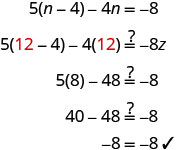 |
|
The solution to is の解はである。 |
Try It (2)確認問題(2題)
Example 2.8例題 2.8
Solve:
英語のヒント
次の方程式を解く:
Solution解答
We simplify both sides of the equation before we isolate the variable.
英語のヒント
変数だけにする前に、方程式の両辺を簡単にする。
 |
|
Distribute on both sides. 両辺で分配法則を使う。 |
 |
Use the Commutative Property of Addition. 加法の交換法則を使う。 |
 |
Combine like terms. 同類項をまとめる。 |
 |
Each side is as simplified as possible. Next, isolate . 各辺はできるだけ簡単になっている。次にだけにする。 |
|
Undo subtraction by using the Addition Property of Equality. 等式の加法の性質を使い、減法を元に戻す。 |
 |
Add. 足す。 |
 |
Check. Let . 確認する。とおく。 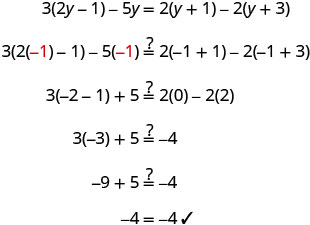 |
|
The solution to is の解はである。 |
Try It (2)確認問題(2題)
Translate to an Equation and Solve方程式で表して解く
To solve applications algebraically, we will begin by translating from English sentences into equations. Our first step is to look for the word (or words) that would translate to the equals sign. Table 2.1 shows us some of the words that are commonly used.
英語のヒント
応用問題を代数で解くために、まず英文を方程式に置き換える。最初の手順は、等号に置き換えられる語を見つけることである。よく使われる語を表2.1に示す。
Equals = 等しい= |
|---|
is is equal to is the same as the result is gives was will be である、に等しい、と同じである、結果は~である、を与える、だった、になる |
The steps we use to translate a sentence into an equation are listed below.
英語のヒント
文を方程式に置き換える手順を、以下に示す。
Example 2.9例題 2.9
Translate and solve: Eleven more than x is equal to 54.
英語のヒント
方程式で表して解く:xより11大きい数は54に等しい。
Solution解答
Translate. 数式で表す。 |
 |
Subtract 11 from both sides. 両辺から11を引く。 |
 |
Simplify. 簡単にする。 |
 |
Check: Is 54 eleven more than 43? 確認:54は43より11大きいか。 |
Try It (2)確認問題(2題)
Example 2.10例題 2.10
Translate and solve: The difference of and is .
英語のヒント
方程式で表して解く:との差はである。
Solution解答
Translate. 数式で表す。 |
 |
Simplify. 簡単にする。 |
 |
Check: 確認: |
Try It (2)確認問題(2題)
Translate and Solve Applications応用問題を方程式に表して解く
Most of the time a question that requires an algebraic solution comes out of a real life question. To begin with that question is asked in English (or the language of the person asking) and not in math symbols. Because of this, it is an important skill to be able to translate an everyday situation into algebraic language.
英語のヒント
代数による解法を必要とする問いは、たいてい実生活の問いから生まれる。最初、その問いは数学の記号ではなく、英語、あるいは質問する人の言語で示される。このため、日常の状況を代数の言葉に置き換えられることは、大切な技能である。
We will start by restating the problem in just one sentence, assign a variable, and then translate the sentence into an equation to solve. When assigning a variable, choose a letter that reminds you of what you are looking for. For example, you might use q for the number of quarters if you were solving a problem about coins.
英語のヒント
まず問題を1つの文に言い換え、変数を決め、文を方程式に置き換えて解く。変数を決めるときは、求めるものを思い出しやすい文字を選ぶ。たとえば硬貨の問題で25セント硬貨の枚数を求めるなら、qを使うとよい。
Example 2.11例題 2.11
How to Solve Translate and Solve Applications応用問題を方程式で表して解く方法
The MacIntyre family recycled newspapers for two months. The two months of newspapers weighed a total of 57 pounds. The second month, the newspapers weighed 28 pounds. How much did the newspapers weigh the first month?
英語のヒント
マッキンタイア家は2か月分の新聞をリサイクルに出した。2か月分の新聞の重さは合計57ポンドだった。2か月目の新聞は28ポンドだった。1か月目の新聞は何ポンドだったか。
Solution解答



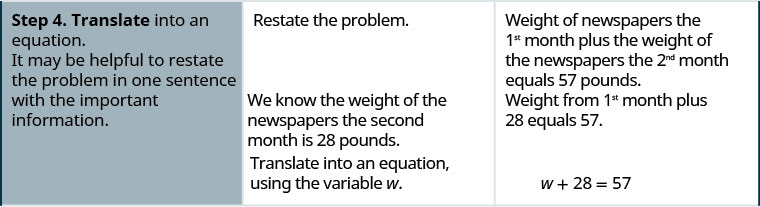

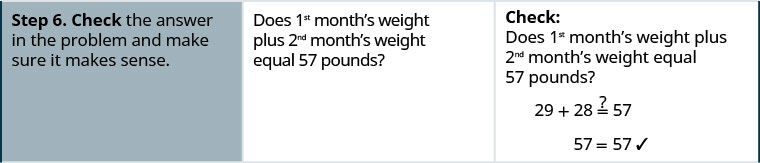

Try It (2)確認問題(2題)
Example 2.12例題 2.12
Randell paid $28,675 for his new car. This was $875 less than the sticker price. What was the sticker price of the car?
英語のヒント
ランデルは新車に28,675ドル支払った。これは表示価格より875ドル安かった。この車の表示価格はいくらだったか。
Solution解答
Step 1. Read the problem. 手順1 問題を読む。 |
|
Step 2. Identify what we are looking for. 手順2 何を求めるのかを明らかにする。 |
"What was the sticker price of the car?" 「車の表示価格はいくらだったか」 |
Step 3. Name what we are looking for. Choose a variable to represent that quantity. 手順3 求めるものに名前を付ける。その量を表す変数を選ぶ。 |
Let the sticker price of the car. 車の表示価格とする。 |
Step 4. Translate into an equation. Restate the problem in one sentence. 手順4 方程式で表す。問題を1つの文に言い換える。 |
$28,675 is $875 less than the sticker price 28,675ドルは表示価格より875ドル安い。 |
Step 5. Solve the equation. 手順5 方程式を解く。 |
|
Step 6. Check the answer. Is $875 less than $29,550 equal to $28,675? 手順6 答えを確かめる。29,550ドルより875ドル安い金額は、28,675ドルに等しいか。 |
|
Step 7. Answer the question with a complete sentence. 手順7.完全な文で問いに答える。 |
The sticker price of the car was $29,550. 車の表示価格は29,550ドルだった。 |