第2章一次方程式と不等式を解く
Classify Equations等式を分類する
Consider the equation we solved at the start of the last section, . The solution we found was . This means the equation is true when we replace the variable, x, with the value . We showed this when we checked the solution and evaluated for .
英語のヒント
前の節の最初に解いた方程式を考えよう。得られた解はだった。つまり、変数xをに置き換えると、方程式が成り立つ。解を確認したときに、としての両辺を計算することで、このことを示した。
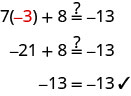
If we evaluate for a different value of x, the left side will not be .
英語のヒント
xに別の値を代入してを計算すると、左辺はにはならない。
The equation is true when we replace the variable, x, with the value , but not true when we replace x with any other value. Whether or not the equation is true depends on the value of the variable. Equations like this are called conditional equations.
英語のヒント
方程式は、変数xをに置き換えると成り立つが、ほかのどの値に置き換えても成り立たない。方程式が成り立つかどうかは、変数の値によって決まる。このような等式を条件付き等式という。
All the equations we have solved so far are conditional equations.
英語のヒント
ここまで解いた方程式は、すべて条件付き等式である。
Now let’s consider the equation . Do you recognize that the left side and the right side are equivalent? Let’s see what happens when we solve for y.
英語のヒント
今度は方程式を考えよう。左辺と右辺が同じ式を表していることに気付くだろうか。yについて解くとどうなるかを見てみよう。
 |
|
Distribute. 分配法則を使う。 |
 |
Subtract to get the ’s to one side. を引いて、を一方の辺にまとめる。 |
 |
Simplify—the ’s are gone! 簡単にすると、がなくなる。 |
 |
But is true.
英語のヒント
しかし、は正しい等式である。
This means that the equation is true for any value of y. We say the solution to the equation is all of the real numbers. An equation that is true for any value of the variable like this is called an identity.
英語のヒント
つまり、方程式はyがどのような値でも成り立つ。この方程式の解は、すべての実数であるという。このように変数がどのような値でも成り立つ等式を、恒等式という。
What happens when we solve the equation ?
英語のヒント
方程式を解くと、どうなるだろうか。
 |
|
Subtract to get the constant alone on the right. を引いて、右辺を定数だけにする。 |
 |
Simplify—the ’s are gone! 簡単にすると、がなくなる。 |
 |
But .
英語のヒント
しかし、である。
Solving the equation led to the false statement . The equation will not be true for any value of z. It has no solution. An equation that has no solution, or that is false for all values of the variable, is called a contradiction.
英語のヒント
方程式を解くと、誤った等式が得られた。方程式は、zがどのような値でも成り立たない。解はない。解がない等式、つまり変数のどの値でも成り立たない等式を、矛盾式という。
Example 2.45例題 2.45
Classify the equation as a conditional equation, an identity, or a contradiction. Then state the solution.
英語のヒント
等式を条件付き等式、恒等式、矛盾式のいずれかに分類する。その後で解を述べる。
Solution解答
 |
|
Distribute. 分配法則を使う。 |
 |
Combine like terms. 同類項をまとめる。 |
 |
Subtract to get the ’s to one side. を引いて、を一方の辺にまとめる。 |
 |
Simplify. 簡単にする。 |
 |
This is a true statement. これは正しい等式である。 |
The equation is an identity. The solution is all real numbers. この等式は恒等式である。解はすべての実数である。 |
Try It (2)確認問題(2題)
Example 2.46例題 2.46
Classify as a conditional equation, an identity, or a contradiction. Then state the solution.
英語のヒント
条件付き等式、恒等式、矛盾式のいずれかに分類する。その後で解を述べる。
Solution解答
 |
|
Distribute. 分配法則を使う。 |
 |
Combine like terms. 同類項をまとめる。 |
 |
Add to both sides. 両辺にを足す。 |
 |
Simplify. 簡単にする。 |
 |
Divide. 割る。 |
 |
Simplify. 簡単にする。 |
 |
The equation is true when . のとき、この等式は成り立つ。 |
This is a conditional equation. The solution is これは条件付き等式である。解はである。 |
Try It (2)確認問題(2題)
Example 2.47例題 2.47
Classify the equation as a conditional equation, an identity, or a contradiction. Then state the solution.
英語のヒント
等式を条件付き等式、恒等式、矛盾式のいずれかに分類する。その後で解を述べる。
Solution解答
 |
|
Distribute. 分配法則を使う。 |
 |
Combine like terms. 同類項をまとめる。 |
 |
Subtract from both sides. 両辺からを引く。 |
 |
Simplify. 簡単にする。 |
 |
But . しかし、である。 |
The equation is a contradiction. It has no solution. この等式は矛盾式である。解はない。 |
Try It (2)確認問題(2題)
Type of equation 等式の種類 |
What happens when you solve it? 解くとどうなるか |
Solution 解答 |
|---|---|---|
Conditional Equation 条件付き等式 |
True for one or more values of the variables and false for all other values 変数の1つ以上の値で成り立ち、それ以外のすべての値では成り立たない |
One or more values 1つ以上の値 |
Identity 恒等式 |
True for any value of the variable 変数のどの値でも成り立つ |
All real numbers すべての実数 |
Contradiction 矛盾式 |
False for all values of the variable 変数のどの値でも成り立たない |
No solution 解なし |