第1章基礎
1.1 Introduction to Whole Numbers1.1 非負整数入門
Learning Objectives学習目標
Learning Objectives学習目標
By the end of this section, you will be able to:
英語のヒント
この節を終えると、次のことができるようになる。
- Use place value with whole numbers
英語のヒント
非負整数の位取りを使う - Identify multiples and apply divisibility tests
英語のヒント
倍数を見分け、割り切れるかどうかの判定法を使う - Find prime factorizations and least common multiples
英語のヒント
素因数分解と最小公倍数を求める
Before You Begin学習の準備
As we begin our study of elementary algebra, we need to refresh some of our skills and vocabulary. This chapter will focus on whole numbers, integers, fractions, decimals, and real numbers. We will also begin our use of algebraic notation and vocabulary.
英語のヒント
初等代数の学習を始めるにあたり、これまでに身に付けた技能や用語を少し復習しておこう。この章では、非負整数、整数、分数、小数、実数を中心に扱う。代数の記号や用語も使い始める。
Use Place Value with Whole Numbers非負整数の位取りを使う
The most basic numbers used in algebra are the numbers we use to count objects in our world: 1, 2, 3, 4, and so on. These are called the counting numbers. Counting numbers are also called natural numbers. If we add zero to the counting numbers, we get the set of whole numbers.
英語のヒント
代数で使う最も基本的な数は、身の回りの物を数えるときに使う1、2、3、4、…である。これらを「数える数」といい、自然数とも呼ぶ。数える数にゼロを加えると、非負整数の集合が得られる。
Counting Numbers: 1, 2, 3, …
英語のヒント
数える数:1、2、3、…
Whole Numbers: 0, 1, 2, 3, …
英語のヒント
非負整数:0、1、2、3、…
The notation “…” is called ellipsis and means “and so on,” or that the pattern continues endlessly.
英語のヒント
「…」という記号は省略記号と呼ばれ、「以下同様」、つまり同じ規則が際限なく続くことを意味する。
We can visualize counting numbers and whole numbers on a number line (see Figure 1.2).
英語のヒント
数える数や非負整数は、数直線上に表して視覚的に捉えられる(図1.2)。

Figure 1.2図 1.2
The numbers on the number line get larger as they go from left to right, and smaller as they go from right to left. While this number line shows only the whole numbers 0 through 6, the numbers keep going without end.
英語のヒント
数直線上の数は左から右へ進むと大きくなり、右から左へ進むと小さくなる。この数直線には0から6までの非負整数しか示されていないが、数は終わりなく続いている。
Additional Resources追加教材
Our number system is called a place value system, because the value of a digit depends on its position in a number. Figure 1.3 shows the place values. The place values are separated into groups of three, which are called periods. The periods are ones, thousands, millions, billions, trillions, and so on. In a written number, commas separate the periods.
英語のヒント
私たちが使う数の表し方は、数字の値が数の中での位置によって決まるため、位取り記数法と呼ばれる。図1.3に各位を示す。位は3桁ずつの区分に分けられ、この区分をピリオドという。区分には、一の区分、千の区分、百万の区分、十億の区分、一兆の区分などがある。数を書くときは、区分をコンマで区切る。
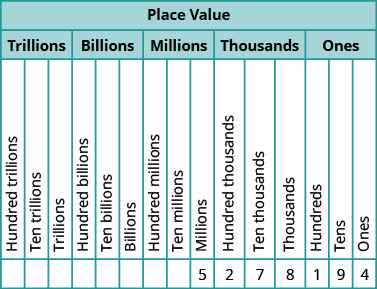
Figure 1.3図 1.3
The number 5,278,194 is shown in the chart. The digit 5 is in the millions place. The digit 2 is in the hundred-thousands place. The digit 7 is in the ten-thousands place. The digit 8 is in the thousands place. The digit 1 is in the hundreds place. The digit 9 is in the tens place. The digit 4 is in the ones place.
英語のヒント
表には5,278,194が示されている。5は百万の位、2は十万の位、7は一万の位、8は千の位、1は百の位、9は十の位、4は一の位にある。
Example 1.1例題 1.1
In the number 63,407,218, find the place value of each digit:
英語のヒント
63,407,218という数で、それぞれの数字の位の値を求めよ。
- ⓐ 7
- ⓑ 0
- ⓒ 1
- ⓓ 6
- ⓔ 3
Solution解答
Place the number in the place value chart:
英語のヒント
数を位取り表に入れる。
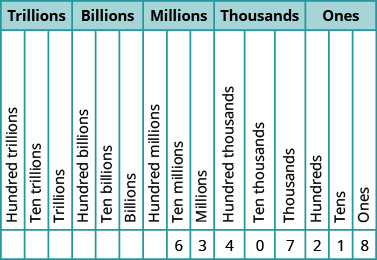
ⓐ The 7 is in the thousands place.
ⓑ The 0 is in the ten thousands place.
ⓒ The 1 is in the tens place.
ⓓ The 6 is in the ten-millions place.
ⓔ The 3 is in the millions place.
ⓑ The 0 is in the ten thousands place.
ⓒ The 1 is in the tens place.
ⓓ The 6 is in the ten-millions place.
ⓔ The 3 is in the millions place.
英語のヒント
ⓐ 7は千の位にある。ⓑ 0は一万の位にある。ⓒ 1は十の位にある。ⓓ 6は千万の位にある。ⓔ 3は百万の位にある。
Try It (2)確認問題(2題)
When you write a check, you write out the number in words as well as in digits. To write a number in words, write the number in each period, followed by the name of the period, without the s at the end. Start at the left, where the periods have the largest value. The ones period is not named. The commas separate the periods, so wherever there is a comma in the number, put a comma between the words (see Figure 1.4). The number 74,218,369 is written as seventy-four million, two hundred eighteen thousand, three hundred sixty-nine.
英語のヒント
小切手を書くときは、数を数字だけでなく言葉でも書く。数を英語の言葉で書くには、区分ごとに数を書き、その後に区分名を付ける。区分名の末尾にはsを付けない。値が最も大きい区分のある左端から始める。一の区分の名前は付けない。コンマは区分を分けるので、数字にコンマがある位置には、言葉の間にもコンマを入れる(図1.4)。74,218,369はseventy-four million, two hundred eighteen thousand, three hundred sixty-nineと書く。
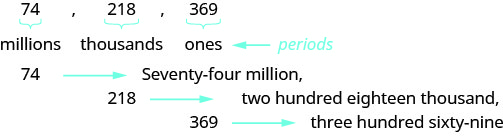
Figure 1.4図 1.4
Example 1.2例題 1.2
Name the number 8,165,432,098,710 using words.
英語のヒント
8,165,432,098,710という数を言葉で表せ。
Solution解答
Name the number in each period, followed by the period name.
英語のヒント
区分ごとに数を読み、その後に区分名を付ける。
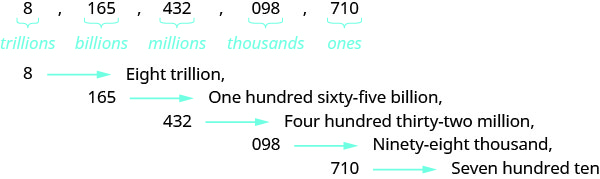
Put the commas in to separate the periods.
英語のヒント
区分を分けるためにコンマを入れる。
So, is named as eight trillion, one hundred sixty-five billion, four hundred thirty-two million, ninety-eight thousand, seven hundred ten.
英語のヒント
したがって、はeight trillion, one hundred sixty-five billion, four hundred thirty-two million, ninety-eight thousand, seven hundred tenと読む。
Try It (2)確認問題(2題)
We are now going to reverse the process by writing the digits from the name of the number. To write the number in digits, we first look for the clue words that indicate the periods. It is helpful to draw three blanks for the needed periods and then fill in the blanks with the numbers, separating the periods with commas.
英語のヒント
今度は逆に、数の読み方から数字を書く。数字で表すには、まず区分を示す手掛かりとなる語を探す。必要な区分ごとに3つの空欄を描き、そこに数字を入れ、区分をコンマで区切るとよい。
Example 1.3例題 1.3
Write nine billion, two hundred forty-six million, seventy-three thousand, one hundred eighty-nine as a whole number using digits.
英語のヒント
nine billion, two hundred forty-six million, seventy-three thousand, one hundred eighty-nineを、数字を使って非負整数で表せ。
Solution解答
Identify the words that indicate periods.
Except for the first period, all other periods must have three places. Draw three blanks to indicate the number of places needed in each period. Separate the periods by commas.
Then write the digits in each period.
Except for the first period, all other periods must have three places. Draw three blanks to indicate the number of places needed in each period. Separate the periods by commas.
Then write the digits in each period.
英語のヒント
区分を示す語を見つける。先頭の区分を除き、すべての区分は3桁でなければならない。各区分に必要な桁数を示すため、空欄を3つ描く。区分をコンマで区切り、それぞれの区分に数字を書く。

The number is 9,246,073,189.
英語のヒント
数は9,246,073,189である。
Try It (2)確認問題(2題)
In 2013, the U.S. Census Bureau estimated the population of the state of New York as 19,651,127. We could say the population of New York was approximately 20 million. In many cases, you don’t need the exact value; an approximate number is good enough.
英語のヒント
2013年、米国国勢調査局はニューヨーク州の人口を19,651,127人と推計した。ニューヨーク州の人口はおよそ2,000万人だった、と言ってもよい。多くの場合、正確な値までは必要なく、おおよその数で十分である。
The process of approximating a number is called rounding. Numbers are rounded to a specific place value, depending on how much accuracy is needed. Saying that the population of New York is approximately 20 million means that we rounded to the millions place.
英語のヒント
数をおおよその値にする操作を、丸めという。必要な正確さに応じて、指定された位に数を丸める。ニューヨーク州の人口が約2,000万人という表現は、百万の位に丸めたことを意味する。
Example 1.4例題 1.4
How to Round Whole Numbers非負整数を四捨五入する方法
Round 23,658 to the nearest hundred.
英語のヒント
23,658を百の位に四捨五入せよ。
Solution解答


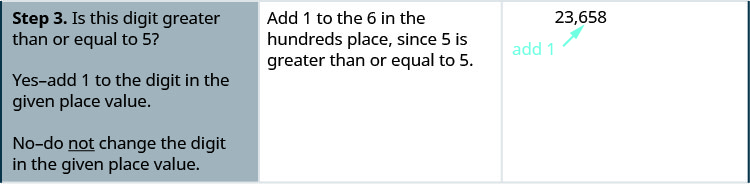

Try It (2)確認問題(2題)
Example 1.5例題 1.5
Round to the nearest:
英語のヒント
を次の位に四捨五入せよ。
- ⓐ hundred
英語のヒント
ⓐ 百の位 - ⓑ thousand
英語のヒント
ⓑ 千の位 - ⓒ ten thousand
英語のヒント
ⓒ 一万の位
Solution解答
ⓐ
Locate the hundreds place in 103,978. 103,978の百の位を見つける。 |
 |
Underline the digit to the right of the hundreds place. 百の位の右隣の数字に下線を引く。 |
 |
Since 7 is greater than or equal to 5, add 1 to the 9. Replace all digits to the right of the hundreds place with zeros. 7は5以上なので、9に1を加える。百の位より右の数字をすべて0に置き換える。 |
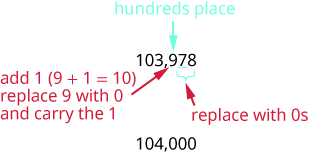 |
So, 104,000 is 103,978 rounded to the nearest hundred. したがって、103,978を百の位に四捨五入すると104,000になる。 |
ⓑ
Locate the thousands place and underline the digit to the right of the thousands place. 千の位を見つけ、その右隣の数字に下線を引く。 |
 |
Since 9 is greater than or equal to 5, add 1 to the 3. Replace all digits to the right of the hundreds place with zeros. 9は5以上なので、3に1を加える。百の位より右の数字をすべて0に置き換える。 |
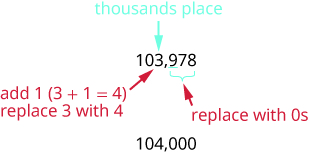 |
So, 104,000 is 103,978 rounded to the nearest thousand. したがって、103,978を千の位に四捨五入すると104,000になる。 |
ⓒ
Locate the ten thousands place and underline the digit to the right of the ten thousands place. 一万の位を見つけ、その右隣の数字に下線を引く。 |
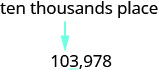 |
Since 3 is less than 5, we leave the 0 as is, and then replace the digits to the right with zeros. 3は5未満なので、0はそのままにし、その右側の数字を0に置き換える。 |
 |
So, 100,000 is 103,978 rounded to the nearest ten thousand. したがって、103,978を一万の位に四捨五入すると100,000になる。 |
Try It (2)確認問題(2題)
In algebra, we use a letter of the alphabet to represent a number whose value may change or is unknown. Commonly used symbols are a, b, c, m, n, x, and y. Further discussion of constants and variables appears later in this section.
英語のヒント
代数では、値が変わることのある数や、値が分かっていない数をアルファベットの文字で表す。よく使われる記号はa、b、c、m、n、x、yである。定数と変数については、この節の後の部分でさらに扱う。