第8章有理式と有理方程式
8.6 Solve Rational Equations8.6 有理方程式を解く
Learning Objectives学習目標
Learning Objectives学習目標
By the end of this section, you will be able to:
英語のヒント
この節を終えると、次のことができるようになる。
- Solve rational equations
英語のヒント
分数方程式を解く - Solve a rational equation for a specific variable
英語のヒント
分数方程式を特定の変数について解く
Before You Begin (3)準備問題(3題)
After defining the terms expression and equation early in Foundations, we have used them throughout this book. We have simplified many kinds of expressions and solved many kinds of equations. We have simplified many rational expressions so far in this chapter. Now we will solve rational equations.
英語のヒント
「基礎」の最初のほうで式と方程式という用語を定義して以来、この本全体でそれらを使ってきた。多くの種類の式を簡単にし、多くの種類の方程式を解いてきた。この章でも、ここまで多くの分数式を簡単にしてきた。次は分数方程式を解く。
The definition of a rational equation is similar to the definition of equation we used in Foundations.
英語のヒント
分数方程式の定義は、「基礎」で使った方程式の定義に似ている。
You must make sure to know the difference between rational expressions and rational equations. The equation contains an equal sign.
英語のヒント
分数式と分数方程式の違いを必ず理解しておく。方程式には等号が含まれる。
Solve Rational Equations有理方程式を解く
We have already solved linear equations that contained fractions. We found the LCD of all the fractions in the equation and then multiplied both sides of the equation by the LCD to “clear” the fractions.
英語のヒント
分数を含む一次方程式はすでに解いた。方程式に含まれるすべての分数のLCDを求め、両辺にLCDを掛けて分数を「なくした」。
Here is an example we did when we worked with linear equations:
英語のヒント
一次方程式を扱ったときの例を示す。
 |
 |
|
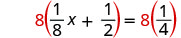
We multiplied both sides by the LCD. 両辺にLCDを掛けた。 |
 |
|
Then we distributed. 次に分配した。 |
 |
|
We simplified—and then we had an equation with no fractions. 簡単にすると、分数を含まない方程式になった。 |
 |
|
Finally, we solved that equation. 最後に、その方程式を解いた。 |
 |
|
 |
We will use the same strategy to solve rational equations. We will multiply both sides of the equation by the LCD. Then we will have an equation that does not contain rational expressions and thus is much easier for us to solve.
英語のヒント
分数方程式も同じ方針で解く。方程式の両辺にLCDを掛ける。すると分数式を含まない方程式になり、はるかに解きやすくなる。
But because the original equation may have a variable in a denominator we must be careful that we don’t end up with a solution that would make a denominator equal to zero.
英語のヒント
ただし、元の方程式では分母に変数がある場合があるため、分母を0にする解を答えにしないよう注意しなければならない。
So before we begin solving a rational equation, we examine it first to find the values that would make any denominators zero. That way, when we solve a rational equation we will know if there are any algebraic solutions we must discard.
英語のヒント
そのため、分数方程式を解き始める前に、まずいずれかの分母を0にする値を調べる。そうすれば、分数方程式を解いたとき、代数的に得た解のうち捨てなければならないものがあるか分かる。
An algebraic solution to a rational equation that would cause any of the rational expressions to be undefined is called an extraneous solution.
英語のヒント
代数的に求めた分数方程式の解のうち、いずれかの分数式を定義できなくするものを無縁解と呼ぶ。
We note any possible extraneous solutions, c, by writing next to the equation.
英語のヒント
無縁解となり得る値cについて、方程式の横にと記す。
Example 8.59例題 8.59
How to Solve Equations with Rational Expressions分数式を含む方程式を解く方法
Solve:
英語のヒント
次の方程式を解く:
Solution解答


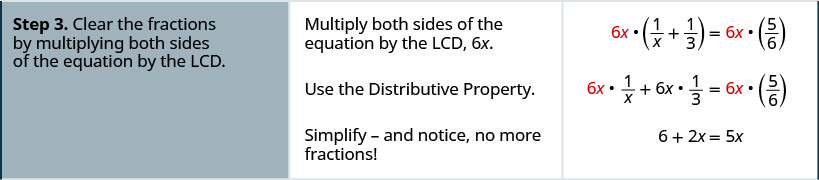

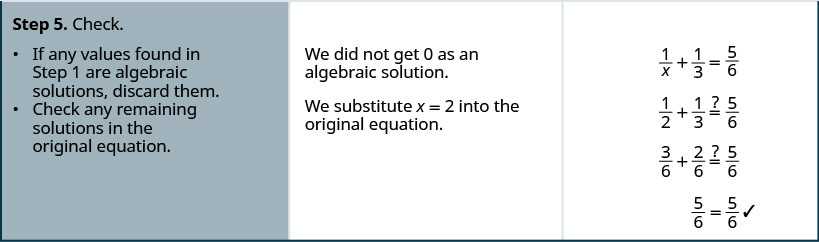
Try It (2)確認問題(2題)
The steps of this method are shown below.
英語のヒント
この方法の手順を以下に示す。
We always start by noting the values that would cause any denominators to be zero.
英語のヒント
まず、いずれかの分母を0にする値を必ず記す。
Example 8.60例題 8.60
Solve:
英語のヒント
次の方程式を解く:
Solution解答
 |
|
Note any value of the variable that would make any denominator zero. いずれかの分母が0になる変数の値を確認する。 |
 |
Find the least common denominator of all denominators in the equation. The LCD is. 方程式にあるすべての分母の最小公分母を求める。最小公分母はである。 |
|
Clear the fractions by multiplying both sides of the equation by the LCD. 方程式の両辺に最小公分母を掛けて分数をなくす。 |
 |
Distribute. 分配法則を使う。 |
 |
Multiply. 掛ける。 |
 |
Solve the resulting equation. First write the quadratic equation in standard form. 得られた方程式を解く。まず二次方程式を標準形で書く。 |
 |
Factor. 因数分解する。 |
 |
Use the Zero Product Property. 積が0になる性質を使う。 |
 |
Solve. 解く。 |
 |
Check. 確かめる。 |
|
We did not get 0 as an algebraic solution. 代数的に得た解に0はなかった。 |
|
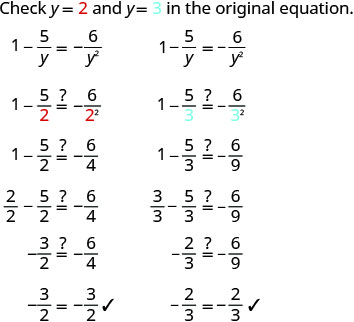 |
Try It (2)確認問題(2題)
Example 8.61例題 8.61
Solve:
英語のヒント
次の方程式を解く:
Solution解答
 |
|
Note any value of the variable that would make any denominator zero. いずれかの分母が0になる変数の値を確認する。 |
 |
Find the least common denominator of all denominators in the equation. The LCD is. 方程式にあるすべての分母の最小公分母を求める。最小公分母はである。 |
|
Clear the fractions by multiplying both sides of the equation by the LCD. 方程式の両辺に最小公分母を掛けて分数をなくす。 |
 |
Remove common factors. 共通の因数を取り除く。 |
 |
Simplify. 簡単にする。 |
 |
Multiply. 掛ける。 |
 |
Solve the resulting equation. 得られた方程式を解く。 |
 |
We did not get 0 or as algebraic solutions. 代数的に得た解に0とはなかった。 |
|
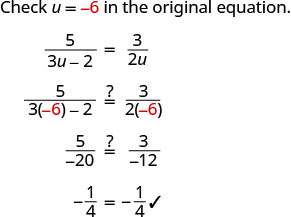 |
Try It (2)確認問題(2題)
When one of the denominators is a quadratic, remember to factor it first to find the LCD.
英語のヒント
分母の一つが二次式の場合は、LCDを求めるために、まず因数分解することを忘れない。
Example 8.62例題 8.62
Solve:
英語のヒント
次の方程式を解く:
Solution解答
 |
|
Note any value of the variable that would make any denominator zero. いずれかの分母が0になる変数の値を確認する。 |
 |
Find the least common denominator of all denominators in the equation. The LCD is. 方程式にあるすべての分母の最小公分母を求める。最小公分母はである。 |
|
Clear the fractions by multiplying both sides of the equation by the LCD. 方程式の両辺に最小公分母を掛けて分数をなくす。 |
 |
Distribute. 分配法則を使う。 |
 |
Remove common factors. 共通の因数を取り除く。 |
 |
Simplify. 簡単にする。 |
 |
Distribute. 分配法則を使う。 |
 |
Solve. 解く。 |
 |
 |
|
 |
|
We did not get as algebraic solutions. 代数的に得た解にはなかった。 |
|
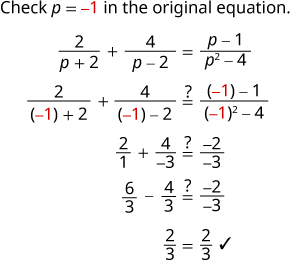 |
Try It (2)確認問題(2題)
Example 8.63例題 8.63
Solve:
英語のヒント
次の方程式を解く:
Solution解答
 |
|
Note any value of the variable that would make any denominator zero. いずれかの分母が0になる変数の値を確認する。 |
 |
Find the least common denominator of all denominators in the equation. The LCD is. 方程式にあるすべての分母の最小公分母を求める。最小公分母はである。 |
|
Clear the fractions by multiplying both sides of the equation by the LCD. 方程式の両辺に最小公分母を掛けて分数をなくす。 |
 |
Distribute. 分配法則を使う。 |
 |
Remove common factors. 共通の因数を取り除く。 |
 |
Simplify. 簡単にする。 |
 |
Simplify. 簡単にする。 |
 |
Combine like terms. 同類項をまとめる。 |
 |
Solve. First write in standard form. 解く。まず標準形で書く。 |
 |
Factor. 因数分解する。 |
 |
Use the Zero Product Property. 積が0になる性質を使う。 |
 |
We did not get 4 or 3 as algebraic solutions. 代数的に得た解に4と3はなかった。 |
|
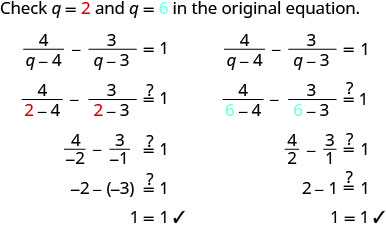 |
Try It (2)確認問題(2題)
Example 8.64例題 8.64
Solve:
英語のヒント
次の方程式を解く:
Solution解答
 |
|
Factor all the denominators, so we can note any value of the variable the would make any denominator zero. いずれかの分母を0にする変数の値を記せるように、すべての分母を因数分解する。 |
 |
Find the least common denominator of all denominators in the equation. The LCD is. 方程式にあるすべての分母の最小公分母を求める。最小公分母はである。 |
|
Clear the fractions. 分母を払う。 |
 |
Distribute. 分配法則を使う。 |
 |
Remove common factors. 共通の因数を取り除く。 |
 |
Simplify. 簡単にする。 |
 |
Solve the resulting equation. 得られた方程式を解く。 |
 |
 |
|
Check. The only algebraic solution was 4, but we said that 4 would make a denominator equal to zero. The algebraic solution is an extraneous solution. There is no solution to this equation. 確かめる。代数的に得られた唯一の解は4だったが、4では分母が0になると述べていた。この代数的に得た解は無縁解である。この方程式に解はない。 |
Try It (2)確認問題(2題)
The equation we solved in Example 8.64 had only one algebraic solution, but it was an extraneous solution. That left us with no solution to the equation. Some equations have no solution.
英語のヒント
例8.64で解いた方程式には、代数的に得られた解が一つだけあったが、それは無縁解だった。その結果、この方程式には解がなかった。解のない方程式もある。
Example 8.65例題 8.65
Solve:
英語のヒント
次の方程式を解く:
Solution解答
 |
|
Note any value of the variable that would make any denominator zero. いずれかの分母が0になる変数の値を確認する。 |
 |
Find the least common denominator of all denominators in the equation. The LCD is. 方程式にあるすべての分母の最小公分母を求める。最小公分母はである。 |
|
Clear the fractions by multiplying both sides of the equation by the LCD. 方程式の両辺に最小公分母を掛けて分数をなくす。 |
 |
Distribute. 分配法則を使う。 |
 |
Remove common factors. 共通の因数を取り除く。 |
 |
Simplify. 簡単にする。 |
 |
Solve the resulting equation. 得られた方程式を解く。 |
 |
 |
|
 |
|
 |
|
Check. 確かめる。 |
|
is an extraneous solution. は無縁解である。 |
|
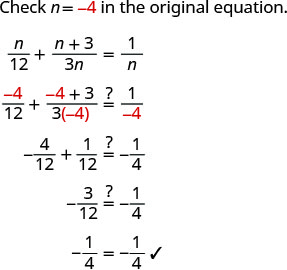 |
Try It (2)確認問題(2題)
Example 8.66例題 8.66
Solve:
英語のヒント
次の方程式を解く:
Solution解答
Solution解答
 |
|
Factor all the denominators, so we can note any value of the variable that would make any denominator zero. いずれかの分母を0にする変数の値を記せるように、すべての分母を因数分解する。 |
 |
Find the least common denominator. The LCD is. 最小公分母を求める。LCDはである。 |
|
Clear the fractions. 分母を払う。 |
 |
Simplify. 簡単にする。 |
 |
Simplify. 簡単にする。 |
 |
Solve the resulting equation. 得られた方程式を解く。 |
 |
 |
|
 |
|
 |
|
 |
|
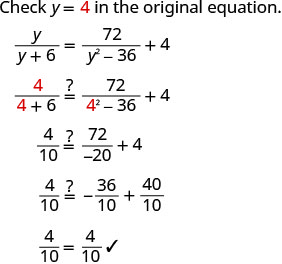
Check. 確かめる。 |
|
is an extraneous solution. は無縁解である。 |
|
 |
Try It (2)確認問題(2題)
Example 8.67例題 8.67
Solve:
英語のヒント
次の方程式を解く:
Solution解答
 |
|
We will start by factoring all denominators, to make it easier to identify extraneous solutions and the LCD. 無縁解とLCDを見つけやすくするため、まずすべての分母を因数分解する。 |
 |
Note any value of the variable that would make any denominator zero. いずれかの分母が0になる変数の値を確認する。 |
 |
Find the least common denominator.The LCD is 最小公分母を求める。LCDはである。 |
|
Clear the fractions. 分母を払う。 |
 |
Simplify. 簡単にする。 |
 |
Simplify. 簡単にする。 |
 |
Solve the resulting equation. 得られた方程式を解く。 |
 |
 |
|
 |
|
 |
|
Check. 確かめる。 |
|
and are extraneous solutions. The equation has no solution. とは無縁解である。この方程式に解はない。 |