第3章数学モデル
3.1 Use a Problem-Solving Strategy3.1 問題解決の手順を使う
Learning Objectives学習目標
Learning Objectives学習目標
By the end of this section, you will be able to:
英語のヒント
この節を終えると、次のことができるようになる。
- Approach word problems with a positive attitude
英語のヒント
前向きな姿勢で文章題に取り組む - Use a problem-solving strategy for word problems
英語のヒント
文章題に問題解決の手順を使う - Solve number problems
英語のヒント
数についての文章題を解く
Before You Begin (3)準備問題(3題)
Approach Word Problems with a Positive Attitude前向きな姿勢で文章題に取り組む
“If you think you can… or think you can’t… you’re right.”—Henry Ford
英語のヒント
「自分にはできると思っても、できないと思っても、あなたは正しい。」—ヘンリー・フォード
The world is full of word problems! Will my income qualify me to rent that apartment? How much punch do I need to make for the party? What size diamond can I afford to buy my girlfriend? Should I fly or drive to my family reunion?
英語のヒント
世界は文章題であふれている。この収入であのアパートを借りる資格はあるだろうか。パーティー用のパンチはどれだけ作ればよいだろうか。恋人にどのくらいの大きさのダイヤモンドを買えるだろうか。親族の集まりには飛行機で行くべきか、車で行くべきか。
How much money do I need to fill the car with gas? How much tip should I leave at a restaurant? How many socks should I pack for vacation? What size turkey do I need to buy for Thanksgiving dinner, and then what time do I need to put it in the oven? If my sister and I buy our mother a present, how much does each of us pay?
英語のヒント
車のガソリンを満タンにするにはいくら必要だろうか。レストランでチップをいくら置くべきだろうか。休暇には靴下を何足持って行けばよいだろうか。感謝祭の夕食にはどのくらいの大きさの七面鳥を買い、何時にオーブンに入れる必要があるだろうか。姉妹と2人で母親のプレゼントを買うなら、それぞれいくら払えばよいだろうか。
Now that we can solve equations, we are ready to apply our new skills to word problems. Do you know anyone who has had negative experiences in the past with word problems? Have you ever had thoughts like the student below?
英語のヒント
方程式を解けるようになったので、新しい技能を文章題に応用する準備ができた。過去に文章題で嫌な経験をした人を知っているだろうか。次の生徒のようなことを考えたことはあるだろうか。
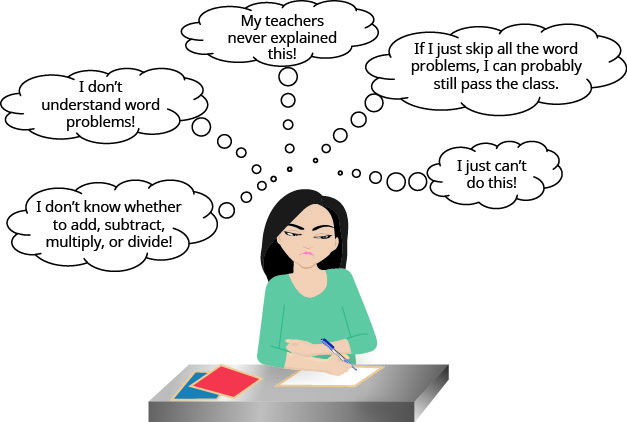
Figure 3.2図 3.2
Negative thoughts can be barriers to success.
英語のヒント
否定的な考えは成功の妨げになりうる。
When we feel we have no control, and continue repeating negative thoughts, we set up barriers to success. We need to calm our fears and change our negative feelings.
英語のヒント
自分ではどうにもできないと感じ、否定的な考えを繰り返すと、成功への障害を自ら作ってしまう。不安を静め、否定的な感情を変える必要がある。
Start with a fresh slate and begin to think positive thoughts. If we take control and believe we can be successful, we will be able to master word problems! Read the positive thoughts in Figure 3.3 and say them out loud.
英語のヒント
気持ちを新たにして、前向きに考え始めよう。自分で状況を動かし、成功できると信じれば、文章題を習得できる。図3.3の前向きな考えを読んで、声に出して言ってみよう。

Figure 3.3図 3.3
Thinking positive thoughts is a first step towards success.
英語のヒント
前向きに考えることが成功への第一歩である。
Think of something, outside of school, that you can do now but couldn’t do 3 years ago. Is it driving a car? Snowboarding? Cooking a gourmet meal? Speaking a new language? Your past experiences with word problems happened when you were younger—now you’re older and ready to succeed!
英語のヒント
学校以外のことで、3年前にはできなかったが今はできることを考えてみよう。車の運転だろうか。スノーボードだろうか。本格的な料理を作ることだろうか。新しい言語を話すことだろうか。文章題に関する過去の経験は、今より幼いときのものだ。今は成長し、成功する準備ができている。
Use a Problem-Solving Strategy for Word Problems文章題に問題解決の手順を使う
We have reviewed translating English phrases into algebraic expressions, using some basic mathematical vocabulary and symbols. We have also translated English sentences into algebraic equations and solved some word problems. The word problems applied math to everyday situations. We restated the situation in one sentence, assigned a variable, and then wrote an equation to solve the problem. This method works as long as the situation is familiar and the math is not too complicated.
英語のヒント
基本的な数学の語彙と記号を使って、英語の語句を代数式に表すことを復習した。また、英文を代数の方程式に表し、いくつかの文章題を解いた。文章題では、数学を日常の状況に応用した。状況を1つの文に書き直し、変数を割り当ててから、問題を解くための方程式を書いた。この方法は、状況が身近で、数学が複雑すぎなければうまくいく。
Now, we’ll expand our strategy so we can use it to successfully solve any word problem. We’ll list the strategy here, and then we’ll use it to solve some problems. We summarize below an effective strategy for problem solving.
英語のヒント
ここでは、この手順を広げ、どのような文章題にも使って解けるようにする。まず手順を示し、それを使っていくつかの問題を解く。以下に、問題解決に有効な手順をまとめる。
Example 3.1例題 3.1
Pilar bought a purse on sale for $18, which is one-half of the original price. What was the original price of the purse?
英語のヒント
ピラールはセールで財布を18ドルで買った。これは元の値段の半分であった。財布の元の値段はいくらだったか。
Solution解答
Step 1. Read the problem. Read the problem two or more times if necessary. Look up any unfamiliar words in a dictionary or on the internet.
英語のヒント
手順1.問題を読む。必要なら2回以上読む。知らない言葉は辞書やインターネットで調べる。
- In this problem, is it clear what is being discussed? Is every word familiar?
英語のヒント
この問題で何について述べているかは明確か。すべての言葉を知っているか。
Step 2. Identify what you are looking for. Did you ever go into your bedroom to get something and then forget what you were looking for? It’s hard to find something if you are not sure what it is! Read the problem again and look for words that tell you what you are looking for!
英語のヒント
手順2.何を求めるのかを明らかにする。何かを取りに寝室に行ってから、何を探していたのか忘れたことはないだろうか。何なのかわからなければ、探し出すのは難しい。問題をもう一度読み、何を求めるのかを示す言葉を探そう。
- In this problem, the words “what was the original price of the purse” tell us what we need to find.
英語のヒント
この問題では、「財布の元の値段はいくらだったか」という言葉が、何を求める必要があるかを示している。
Step 3. Name what we are looking for. Choose a variable to represent that quantity. We can use any letter for the variable, but choose one that makes it easy to remember what it represents.
英語のヒント
手順3.求めるものを文字で表す。その量を表す変数を選ぶ。変数にはどの文字を使ってもよいが、何を表すか覚えやすいものを選ぼう。
- Let the original price of the purse.
英語のヒント
財布の元の値段、とおく。
Step 4. Translate into an equation. It may be helpful to restate the problem in one sentence with all the important information. Translate the English sentence into an algebraic equation.
英語のヒント
手順4.方程式に表す。重要な情報をすべて含む1つの文に問題を書き直すと役立つことがある。その英文を代数の方程式に表す。
Reread the problem carefully to see how the given information is related. Often, there is one sentence that gives this information, or it may help to write one sentence with all the important information. Look for clue words to help translate the sentence into algebra. Translate the sentence into an equation.
英語のヒント
問題を注意深く読み直し、与えられた情報がどのように関係しているかを調べる。多くの場合、この情報を示す文が1つある。また、重要な情報をすべて含む文を1つ書くと役立つこともある。文を代数式に表す手がかりとなる言葉を探し、その文を方程式に表す。
Restate the problem in one sentence with all the important information. 重要な情報をすべて含む1つの文に問題を書き直す。 |
 |
Translate into an equation. 方程式で表す。 |
 |
Step 5. Solve the equation using good algebraic techniques. Even if you know the solution right away, using good algebraic techniques here will better prepare you to solve problems that do not have obvious answers.
英語のヒント
手順5.適切な代数の手順を使って方程式を解く。解がすぐわかる場合でも、ここで適切な代数の手順を使っておけば、答えが明らかでない問題を解くための準備がさらに整う。
Solve the equation. 方程式を解く。 |
 |
Multiply both sides by 2. 両辺に2を掛ける。 |
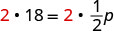 |
Simplify. 簡単にする。 |
 |
Step 6. Check the answer in the problem to make sure it makes sense. We solved the equation and found that which means “the original price” was $36.
英語のヒント
手順6.答えを問題に戻して確認し、筋が通っていることを確かめる。方程式を解くととなった。これは「元の値段」が36ドルだったことを意味する。
- Does $36 make sense in the problem? Yes, because 18 is one-half of 36, and the purse was on sale at half the original price.
英語のヒント
この問題で36ドルという値は筋が通っているか。通っている。18は36の半分であり、財布は元の値段の半額で売られていたからである。
Step 7. Answer the question with a complete sentence. The problem asked “What was the original price of the purse?”
英語のヒント
手順7.完全な文で問いに答える。問題では「財布の元の値段はいくらだったか」と尋ねていた。
- The answer to the question is: “The original price of the purse was $36.”
英語のヒント
問いへの答えは「財布の元の値段は36ドルだった」である。
If this were a homework exercise, our work might look like this:
英語のヒント
これが宿題なら、解答は次のように書ける。
Pilar bought a purse on sale for $18, which is one-half the original price. What was the original price of the purse?
英語のヒント
ピラールはセールで財布を18ドルで買った。これは元の値段の半分であった。財布の元の値段はいくらだったか。
Let the original price. 元の値段、とおく。 |
|
18 is one-half the original price. 18は元の値段の半分である。 |
|
 |
|
Multiply both sides by 2. 両辺に2を掛ける。 |
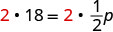 |
Simplify. 簡単にする。 |
 |
Check. Is $36 a reasonable price for a purse? 確認する。36ドルは財布の値段として妥当か。 |
|
Yes. はい。 |
|
Is 18 one half of 36? 18は36の半分か。 |
|
The original price of the purse was $36. 財布の元の値段は36ドルだった。 |
Try It (2)確認問題(2題)
Let’s try this approach with another example.
英語のヒント
別の例題でこの方法を試そう。
Example 3.2例題 3.2
Ginny and her classmates formed a study group. The number of girls in the study group was three more than twice the number of boys. There were 11 girls in the study group. How many boys were in the study group?
英語のヒント
ジニーとクラスメートたちは勉強会を作った。勉強会の女子の人数は男子の人数の2倍より3人多かった。女子は11人いた。男子は何人いたか。
Solution解答
Step 1. Read the problem. 手順1 問題を読む。 |
|
Step 2. Identify what we are looking for. 手順2.何を求めるのかを明らかにする。 |
How many boys were in the study group? 勉強会の男子は何人いたか。 |
Step 3. Name. Choose a variable to represent the number of boys. 手順3.文字で表す。男子の人数を表す変数を選ぶ。 |
Let the number of boys. 男子の人数、とおく。 |
Step 4. Translate. Restate the problem in one sentence with all the important information. 手順4.数式に表す。重要な情報をすべて含む1つの文に問題を書き直す。 |
 |
Translate into an equation. 方程式で表す。 |
 |
Step 5. Solve the equation. 手順5 方程式を解く。 |
 |
Subtract 3 from each side. 両辺から3を引く。 |
 |
Simplify. 簡単にする。 |
 |
Divide each side by 2. 両辺を2で割る。 |
 |
Simplify. 簡単にする。 |
 |
Step 6. Check. First, is our answer reasonable? Yes, having 4 boys in a study group seems OK. The problem says the number of girls was 3 more than twice the number of boys. If there are four boys, does that make eleven girls? Twice 4 boys is 8. Three more than 8 is 11. 手順6.確認する。まず、答えは妥当か。勉強会に男子が4人いるのは妥当と思われる。問題では、女子の人数は男子の人数の2倍より3人多いとしている。男子が4人なら女子は11人になるか。4人の2倍は8人であり、8人より3人多いのは11人である。 |
|
Step 7. Answer the question. 手順7 問いに答える。 |
There were 4 boys in the study group. 勉強会には男子が4人いた。 |