第4章グラフ
Use Slopes to Identify Parallel Lines傾きを使って平行な直線を見分ける
The slope of a line indicates how steep the line is and whether it rises or falls as we read it from left to right. Two lines that have the same slope are called parallel lines. Parallel lines never intersect.
英語のヒント
直線の傾きは、直線がどれほど急か、左から右へ読むと上がるか下がるかを示す。傾きが等しい2本の直線を平行な直線という。平行な直線は決して交わらない。

We say this more formally in terms of the rectangular coordinate system. Two lines that have the same slope and different y-intercepts are called parallel lines. See Figure 4.27.
英語のヒント
直交座標系を使って、これをより厳密に述べよう。傾きが等しく、y切片が異なる2本の直線を平行な直線という。図4.27を参照する。
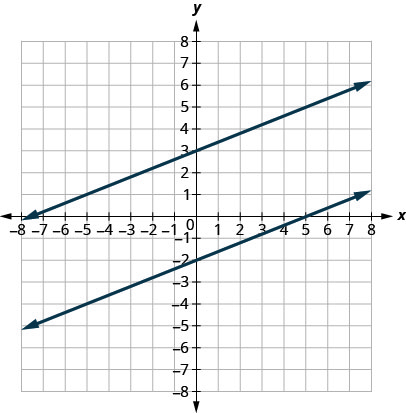
Figure 4.27図 4.27
Verify that both lines have the same slope, , and different y-intercepts.
英語のヒント
2本の直線の傾きがどちらもで等しく、y切片が異なることを確認せよ。
What about vertical lines? The slope of a vertical line is undefined, so vertical lines don’t fit in the definition above. We say that vertical lines that have different x-intercepts are parallel. See Figure 4.28.
英語のヒント
垂直な直線はどうだろうか。垂直な直線の傾きは定義されないので、上の定義には当てはまらない。x切片が異なる垂直な直線は平行であるという。図4.28を参照する。
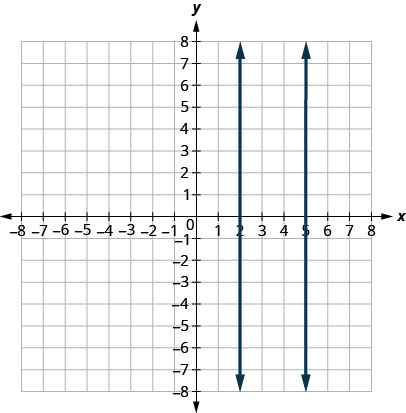
Figure 4.28図 4.28
Vertical lines with diferent x-intercepts are parallel.
英語のヒント
x切片が異なる垂直な直線は平行である。
Let’s graph the equations and on the same grid. The first equation is already in slope–intercept form: . We solve the second equation for :
英語のヒント
方程式とのグラフを同じ格子上に描こう。最初の方程式は、すでに傾き・切片形である。2つ目の方程式をについて解く:
Graph the lines.
英語のヒント
直線のグラフを描く。
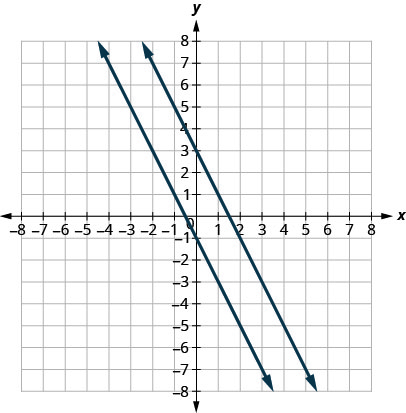
Notice the lines look parallel. What is the slope of each line? What is the y-intercept of each line?
英語のヒント
直線が平行に見えることに注目する。それぞれの直線の傾きはいくつか。y切片は何か。
The slopes of the lines are the same and the y-intercept of each line is different. So we know these lines are parallel.
英語のヒント
直線の傾きは等しく、y切片は異なる。したがって、この2本の直線は平行だとわかる。
Since parallel lines have the same slope and different y-intercepts, we can now just look at the slope–intercept form of the equations of lines and decide if the lines are parallel.
英語のヒント
平行な直線は傾きが等しく、y切片が異なるので、傾き・切片形の方程式を見るだけで、直線が平行かどうか判断できる。
Example 4.51例題 4.51
Use slopes and y-intercepts to determine if the lines and are parallel.
英語のヒント
傾きとy切片を使って、直線とが平行かどうかを判定する。
Solution解答
Solve the first equation for . 最初の方程式をについて解く。 |
and および |
||
The equation is now in slope-intercept form. これで方程式は傾き・切片形になった。 |
|||
The equation of the second line is already in slope-intercept form. 2本目の直線の方程式は、すでに傾き・切片形である。 |
|||
Identify the slope and -intercept of both lines. 両方の直線の傾きと切片を特定する。 |
|||
The lines have the same slope and different y-intercepts and so they are parallel. You may want to graph the lines to confirm whether they are parallel.
英語のヒント
傾きが等しく、y切片が異なるので、直線は平行である。グラフを描いて、本当に平行か確かめてみてもよい。
Try It (2)確認問題(2題)
Example 4.52例題 4.52
Use slopes and y-intercepts to determine if the lines and are parallel.
英語のヒント
傾きとy切片を使って、直線とが平行かどうかを判定する。
Solution解答
and および |
|||
Write each equation in slope-intercept form. それぞれの方程式を傾き・切片形で書く。 |
|||
Since there is no term we write . の項がないので、と書く。 |
|||
Identify the slope and -intercept of both lines. 両方の直線の傾きと切片を特定する。 |
|||
The lines have the same slope and different y-intercepts and so they are parallel.
英語のヒント
傾きが等しく、y切片が異なるので、直線は平行である。
There is another way you can look at this example. If you recognize right away from the equations that these are horizontal lines, you know their slopes are both 0. Since the horizontal lines cross the y-axis at and at , we know the y-intercepts are and . The lines have the same slope and different y-intercepts and so they are parallel.
英語のヒント
この例には別の見方もある。方程式からすぐに水平な直線だと気づけば、傾きはどちらも0だとわかる。水平な直線は、y軸とおよびで交わるので、y切片はとである。傾きが等しく、y切片が異なるので、直線は平行である。
Try It (2)確認問題(2題)
Example 4.53例題 4.53
Use slopes and y-intercepts to determine if the lines and are parallel.
英語のヒント
傾きとy切片を使って、直線とが平行かどうかを判定する。
Solution解答
Since there is no, the equations cannot be put in slope–intercept form. But we recognize them as equations of vertical lines. Their x-intercepts are and . Since their x-intercepts are different, the vertical lines are parallel.
英語のヒント
がないので、この方程式は傾き・切片形にできない。しかし、垂直な直線の方程式だとわかる。x切片はとである。x切片が異なるので、この垂直な直線は平行である。
Try It (2)確認問題(2題)
Example 4.54例題 4.54
Use slopes and y-intercepts to determine if the lines and are parallel. You may want to graph these lines, too, to see what they look like.
英語のヒント
傾きとy切片を使って、直線とが平行かどうか判定せよ。グラフも描いて、どのように見えるか確かめてみてもよい。
Solution解答
and および |
|||
The first equation is already in slope-intercept form. 最初の方程式は、すでに傾き・切片形である。 |
|||
Solve the second equation for . 2つ目の方程式をについて解く。 |
|||
The second equation is now in slope-intercept form. これで2つ目の方程式は傾き・切片形になった。 |
|||
Identify the slope and -intercept of both lines. 両方の直線の傾きと切片を特定する。 |
|||
The lines have the same slope, but they also have the same y-intercepts. Their equations represent the same line. They are not parallel; they are the same line.
英語のヒント
傾きは等しいが、y切片も等しい。この2つの方程式は同じ直線を表す。平行な直線ではなく、同じ直線である。