第1章基礎
Identify Multiples and Apply Divisibility Tests倍数を見分け、割り切れるかどうかの判定法を使う
The numbers 2, 4, 6, 8, 10, and 12 are called multiples of 2. A multiple of 2 can be written as the product of 2 and a counting number.
英語のヒント
2、4、6、8、10、12は2の倍数と呼ばれる。2の倍数は、2と数える数との積として書ける。

Similarly, a multiple of 3 would be the product of a counting number and 3.
英語のヒント
同様に、3の倍数は、数える数と3との積として表せる。

We could find the multiples of any number by continuing this process.
英語のヒント
この手順を続ければ、どの数の倍数も求められる。
Additional Resources追加教材
Table 1.1 shows the multiples of 2 through 9 for the first 12 counting numbers.
英語のヒント
表1.1は、2から9までのそれぞれの数に、最初の12個の数える数を掛けて得られる倍数を示している。
Counting Number 数える数 |
1 |
2 |
3 |
4 |
5 |
6 |
7 |
8 |
9 |
10 |
11 |
12 |
|---|---|---|---|---|---|---|---|---|---|---|---|---|
Multiples of 2 2の倍数 |
2 |
4 |
6 |
8 |
10 |
12 |
14 |
16 |
18 |
20 |
22 |
24 |
Multiples of 3 3の倍数 |
3 |
6 |
9 |
12 |
15 |
18 |
21 |
24 |
27 |
30 |
33 |
36 |
Multiples of 4 4の倍数 |
4 |
8 |
12 |
16 |
20 |
24 |
28 |
32 |
36 |
40 |
44 |
48 |
Multiples of 5 5の倍数 |
5 |
10 |
15 |
20 |
25 |
30 |
35 |
40 |
45 |
50 |
55 |
60 |
Multiples of 6 6の倍数 |
6 |
12 |
18 |
24 |
30 |
36 |
42 |
48 |
54 |
60 |
66 |
72 |
Multiples of 7 7の倍数 |
7 |
14 |
21 |
28 |
35 |
42 |
49 |
56 |
63 |
70 |
77 |
84 |
Multiples of 8 8の倍数 |
8 |
16 |
24 |
32 |
40 |
48 |
56 |
64 |
72 |
80 |
88 |
96 |
Multiples of 9 9の倍数 |
9 |
18 |
27 |
36 |
45 |
54 |
63 |
72 |
81 |
90 |
99 |
108 |
Multiples of 10 10の倍数 |
10 |
20 |
30 |
40 |
50 |
60 |
70 |
80 |
90 |
100 |
110 |
120 |
Another way to say that 15 is a multiple of 3 is to say that 15 is divisible by 3. That means that when we divide 15 by 3, we get a counting number. In fact, is 5, so 15 is
英語のヒント
15は3の倍数であるということを、15は3で割り切れるともいう。つまり15を3で割ると、数える数になる。実際、は5なので、15はとなる。
Look at the multiples of 5 in Table 1.1. They all end in 5 or 0. Numbers with last digit of 5 or 0 are divisible by 5. Looking for other patterns in Table 1.1 that shows multiples of the numbers 2 through 9, we can discover the following divisibility tests:
英語のヒント
Example 1.6例題 1.6
Is 5,625 divisible by 2? By 3? By 5? By 6? By 10?
英語のヒント
5,625は2で割り切れるか。3、5、6、10ではどうか。
Solution解答
Is 5,625 divisible by 2? 5,625は2で割り切れるか。 |
|
Does it end in 0,2,4,6, or 8? 末尾は0、2、4、6、8のいずれかか。 |
No. 5,625 is not divisible by 2. いいえ。5,625は2で割り切れない。 |
Is 5,625 divisible by 3? 5,625は3で割り切れるか。 |
|
What is the sum of the digits? 各桁の数字の和はいくつか。 |
|
Is the sum divisible by 3? その和は3で割り切れるか。 |
Yes. 5,625 is divisble by 3. はい。5,625は3で割り切れる。 |
Is 5,625 divisible by 5 or 10? 5,625は5または10で割り切れるか。 |
|
What is the last digit? It is 5. 最後の数字はいくつか。5である。 |
5,625 is divisble by 5 but not by 10. 5,625は5で割り切れるが、10では割り切れない。 |
Is 5,625 divisible by 6? 5,625は6で割り切れるか。 |
|
Is it divisible by both 2 and 3? 2と3の両方で割り切れるか。 |
No, 5,625 is not divisible by 2, so 5,625 is not divisible by 6. いいえ。5,625は2で割り切れないので、6でも割り切れない。 |
Try It (2)確認問題(2題)
Find Prime Factorizations and Least Common Multiples素因数分解と最小公倍数を求める
In mathematics, there are often several ways to talk about the same ideas. So far, we’ve seen that if m is a multiple of n, we can say that m is divisible by n. For example, since 72 is a multiple of 8, we say 72 is divisible by 8. Since 72 is a multiple of 9, we say 72 is divisible by 9. We can express this still another way.
英語のヒント
数学では、同じ考えをいくつかの異なる言い方で表すことがよくある。これまでに、mがnの倍数なら、mはnで割り切れるといえることを見た。たとえば72は8の倍数なので、72は8で割り切れるという。72は9の倍数なので、72は9で割り切れるという。これをさらに別の言い方で表せる。
Since we say that 8 and 9 are factors of 72. When we write we say we have factored 72.
英語のヒント
なので、8と9は72の因数であるという。と書くことを、72を因数分解するという。
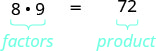
Other ways to factor 72 are Seventy-two has many factors: 1, 2, 3, 4, 6, 8, 9, 12, 18, 36, and 72.
英語のヒント
72の因数分解には、ほかにもがある。72には、1、2、3、4、6、8、9、12、18、36、72という多くの因数がある。
Some numbers, like 72, have many factors. Other numbers have only two factors.
英語のヒント
72のように因数が多い数もあれば、因数が二つしかない数もある。
Additional Resources追加教材
Additional Resources追加教材
The counting numbers from 2 to 19 are listed in Figure 1.5, with their factors. Make sure to agree with the “prime” or “composite” label for each!
英語のヒント
図1.5には、2から19までの数える数とその因数を示している。それぞれに付けられた「素数」「合成数」という分類が正しいことを確かめよう。
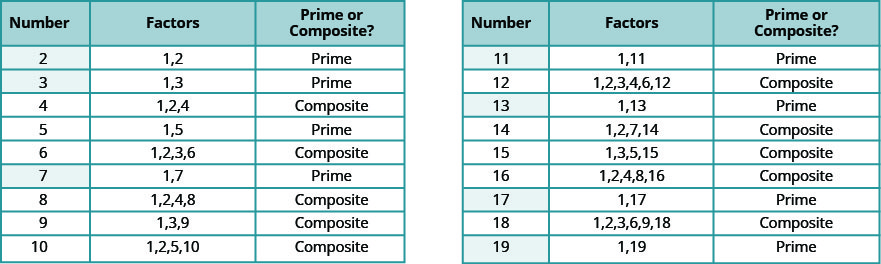
Figure 1.5図 1.5
The prime numbers less than 20 are 2, 3, 5, 7, 11, 13, 17, and 19. Notice that the only even prime number is 2.
英語のヒント
20未満の素数は2、3、5、7、11、13、17、19である。偶数の素数は2だけであることに注目しよう。
A composite number can be written as a unique product of primes. This is called the prime factorization of the number. Finding the prime factorization of a composite number will be useful later in this course.
英語のヒント
合成数は、素数の積として一通りに表せる。これをその数の素因数分解という。合成数の素因数分解を求めることは、この先の学習で役立つ。
To find the prime factorization of a composite number, find any two factors of the number and use them to create two branches. If a factor is prime, that branch is complete. Circle that prime!
英語のヒント
合成数を素因数分解するには、その数を積で表す二つの因数を見つけ、二本の枝を作る。因数が素数なら、その枝は完成である。その素数を丸で囲もう。
If the factor is not prime, find two factors of the number and continue the process. Once all the branches have circled primes at the end, the factorization is complete. The composite number can now be written as a product of prime numbers.
英語のヒント
因数が素数でなければ、その数を積で表す二つの因数を見つけ、同じ手順を続ける。すべての枝の先に、丸で囲まれた素数があれば分解は完了である。これで合成数を素数の積として書ける。
Example 1.7例題 1.7
How to Find the Prime Factorization of a Composite Number合成数を素因数分解する方法
Factor 48.
英語のヒント
48を因数分解せよ。
Solution解答


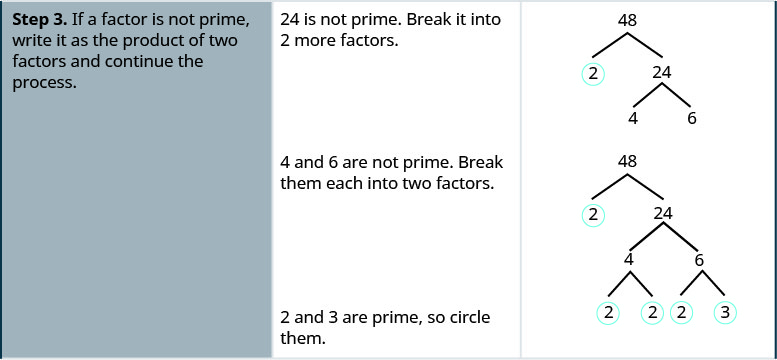

We say is the prime factorization of 48. We generally write the primes in ascending order. Be sure to multiply the factors to verify your answer!
英語のヒント
を48の素因数分解という。通常、素数は小さい順に書く。必ず因数を掛け合わせ、答えが正しいことを確かめよう。
If we first factored 48 in a different way, for example as the result would still be the same. Finish the prime factorization and verify this for yourself.
英語のヒント
最初に48を別の形、たとえばに分解しても、結果は同じになる。素因数分解を完成させ、自分で確かめよう。
Try It (2)確認問題(2題)
Example 1.8例題 1.8
Find the prime factorization of 252.
英語のヒント
252の素因数分解を求めよ。
Solution解答
Step 1. Find two factors whose product is 252. 12 and 21 are not prime. Break 12 and 21 into two more factors. Continue until all primes are factored. 手順1.積が252になる二つの因数を見つける。12も21も素数ではない。それぞれをさらに二つの因数に分け、すべてが素因数になるまで続ける。 |
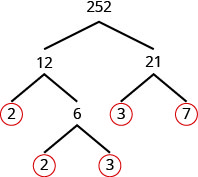 |
Step 2. Write 252 as the product of all the circled primes. 手順2.252を、丸で囲んだすべての素数の積として表す。 |
Try It (2)確認問題(2題)
One of the reasons we look at multiples and primes is to use these techniques to find the least common multiple of two numbers. This will be useful when we add and subtract fractions with different denominators. Two methods are used most often to find the least common multiple and we will look at both of them.
英語のヒント
倍数と素数を学ぶ理由の一つは、これらを使って二つの数の最小公倍数を求めるためである。これは、分母の異なる分数の足し算や引き算で役立つ。最小公倍数を求めるためによく使われる二つの方法を、両方とも見ていこう。
The first method is the Listing Multiples Method. To find the least common multiple of 12 and 18, we list the first few multiples of 12 and 18:
英語のヒント
最初は、倍数を書き並べる方法である。12と18の最小公倍数を求めるため、それぞれの倍数を小さい方からいくつか書く。
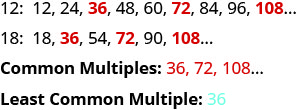
Notice that some numbers appear in both lists. They are the common multiples of 12 and 18.
英語のヒント
両方の列に現れる数があることに注目しよう。これらは12と18の公倍数である。
We see that the first few common multiples of 12 and 18 are 36, 72, and 108. Since 36 is the smallest of the common multiples, we call it the least common multiple. We often use the abbreviation LCM.
英語のヒント
12と18の公倍数を小さい方から並べると、36、72、108となる。36は公倍数の中で最も小さいので、最小公倍数と呼ぶ。略してLCMと書くことが多い。
The procedure box lists the steps to take to find the LCM using the prime factors method we used above for 12 and 18.
英語のヒント
手順の枠には、先ほど12と18で使った素因数による方法で、最小公倍数を求める手順を示している。
Example 1.9例題 1.9
Find the least common multiple of 15 and 20 by listing multiples.
英語のヒント
倍数を書き並べて、15と20の最小公倍数を求めよ。
Solution解答
Make lists of the first few multiples of 15 and of 20, and use them to find the least common multiple. 15と20それぞれの倍数を小さい方からいくつか書き並べ、それを使って最小公倍数を求める。 |
 |
Look for the smallest number that appears in both lists. 両方の列に現れる最も小さい数を探す。 |
The first number to appear on both lists is 60, so 60 is the least common multiple of 15 and 20. 両方の列に最初に現れる数は60なので、15と20の最小公倍数は60である。 |
Notice that 120 is in both lists, too. It is a common multiple, but it is not the least common multiple.
英語のヒント
120も両方の列にあることに注目しよう。これは公倍数だが、最小公倍数ではない。
Try It (2)確認問題(2題)
Our second method to find the least common multiple of two numbers is to use The Prime Factors Method. Let’s find the LCM of 12 and 18 again, this time using their prime factors.
英語のヒント
二つ目は、素因数を使って最小公倍数を求める方法である。12と18の最小公倍数を、今度は素因数を使ってもう一度求めてみよう。
Example 1.10例題 1.10
How to Find the Least Common Multiple Using the Prime Factors Method素因数を使って最小公倍数を求める方法
Find the Least Common Multiple (LCM) of 12 and 18 using the prime factors method.
英語のヒント
素因数を使って、12と18の最小公倍数(LCM)を求めよ。
Solution解答
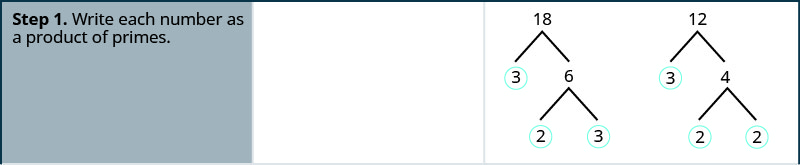



Notice that the prime factors of 12 and the prime factors of 18 are included in the LCM So 36 is the least common multiple of 12 and 18.
英語のヒント
12の素因数と18の素因数は、どちらも最小公倍数のに含まれている。したがって、12と18の最小公倍数は36である。
By matching up the common primes, each common prime factor is used only once. This way you are sure that 36 is the least common multiple.
英語のヒント
共通の素因数をそろえることで、それぞれの共通する素因数を一度だけ使う。この方法なら、36が最小公倍数であることを確かめられる。
Try It (2)確認問題(2題)
Example 1.11例題 1.11
Find the Least Common Multiple (LCM) of 24 and 36 using the prime factors method.
英語のヒント
素因数を使って、24と36の最小公倍数(LCM)を求めよ。
Solution解答
Solution解答
Find the primes of 24 and 36. Match primes vertically when possible. Bring down all columns. 24と36の素因数を求め、同じ素因数はできるだけ上下にそろえる。すべての列の数を下ろす。 |
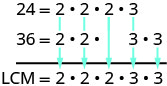 |
Multiply the factors. 因数どうしを掛ける。 |
 |
The LCM of 24 and 36 is 72. 24と36の最小公倍数は72である。 |