第1章基礎
1.3 Add and Subtract Integers1.3 整数の加法と減法
Learning Objectives学習目標
Learning Objectives学習目標
By the end of this section, you will be able to:
英語のヒント
この節を終えると、次のことができるようになる。
- Use negatives and opposites
英語のヒント
負の数と符号を逆にした数を使う - Simplify: expressions with absolute value
英語のヒント
絶対値を含む式を簡単にする - Add integers
英語のヒント
整数を足す - Subtract integers
英語のヒント
整数を引く
Before You Begin学習の準備
Use Negatives and Opposites負の数と符号を逆にした数を使う
Our work so far has only included the counting numbers and the whole numbers. But if you have ever experienced a temperature below zero or accidentally overdrawn your checking account, you are already familiar with negative numbers. Negative numbers are numbers less than The negative numbers are to the left of zero on the number line. See Figure 1.6.
英語のヒント
これまでは、数える数と非負整数だけを扱ってきた。しかし、氷点下の気温を経験したり、誤って当座預金の残高を超えて引き出したりしたことがあれば、すでに負の数になじみがある。負の数はより小さい数であり、数直線上ではゼロの左側にある。図1.6を見よう。
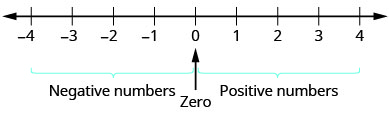
Figure 1.6図 1.6
The number line shows the location of positive and negative numbers.
英語のヒント
数直線は、正の数と負の数の位置を示している。
The arrows on the ends of the number line indicate that the numbers keep going forever. There is no biggest positive number, and there is no smallest negative number.
英語のヒント
数直線の両端の矢印は、数がどこまでも続くことを示す。最も大きい正の数も、最も小さい負の数も存在しない。
Is zero a positive or a negative number? Numbers larger than zero are positive, and numbers smaller than zero are negative. Zero is neither positive nor negative.
英語のヒント
ゼロは正の数だろうか、負の数だろうか。ゼロより大きい数は正、ゼロより小さい数は負である。ゼロは正でも負でもない。
Consider how numbers are ordered on the number line. Going from left to right, the numbers increase in value. Going from right to left, the numbers decrease in value. See Figure 1.7.
英語のヒント
数直線上の数の並び方を考えよう。左から右へ進むと数の値は大きくなり、右から左へ進むと小さくなる。図1.7を見よう。
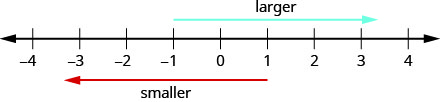
Figure 1.7図 1.7
The numbers on a number line increase in value going from left to right and decrease in value going from right to left.
英語のヒント
数直線上の数は、左から右へ進むと大きくなり、右から左へ進むと小さくなる。
Additional Resources追加教材
Remember that we use the notation:
英語のヒント
次の表記を思い出そう。
a < b (read “a is less than b”) when a is to the left of b on the number line.
英語のヒント
数直線上でaがbの左にあるとき、a < bと書き、「aはbより小さい」と読む。
a > b (read “a is greater than b”) when a is to the right of b on the number line.
英語のヒント
数直線上でaがbの右にあるとき、a > bと書き、「aはbより大きい」と読む。
Now we need to extend the number line which showed the whole numbers to include negative numbers, too. The numbers marked by points in Figure 1.8 are called the integers. The integers are the numbers
英語のヒント
非負整数を示していた数直線を、負の数も含むように広げよう。図1.8で点を付けた数を整数という。整数とはという数である。

Figure 1.8図 1.8
All the marked numbers are called integers.
英語のヒント
印を付けた数は、すべて整数と呼ばれる。
Example 1.30例題 1.30
Order each of the following pairs of numbers, using < or >: ⓐ ⓑ ⓒ ⓓ
英語のヒント
<または>を使い、各組の数の大小を示せ。ⓐ ⓑ ⓒ ⓓ
Solution解答
It may be helpful to refer to the number line shown.
英語のヒント
示された数直線を参考にするとよい。

ⓐ 14 is to the right of 6 on the number line. ⓐ 数直線上で14は6の右にある。 |
|
ⓑ −1 is to the left of 9 on the number line. ⓑ 数直線上で−1は9の左にある。 |
|
ⓒ −1 is to the right of −4 on the number line. ⓒ 数直線上で−1は−4の右にある。 |
|
ⓓ 2 is to the right of −20 on the number line. ⓓ 数直線上で2は−20の右にある。 |
Try It (2)確認問題(2題)
You may have noticed that, on the number line, the negative numbers are a mirror image of the positive numbers, with zero in the middle. Because the numbers 2 and are the same distance from zero, they are called opposites. The opposite of 2 is and the opposite of is 2.
英語のヒント
数直線上では、ゼロを中央として、負の数と正の数が鏡に映したような位置にあることに気付いただろうか。2とはゼロからの距離が等しいので、互いに符号を逆にした数という。2の符号を逆にした数は、の符号を逆にした数は2である。

Figure 1.9図 1.9
The opposite of 3 is
英語のヒント
3の符号を逆にした数はである。
Sometimes in algebra the same symbol has different meanings. Just like some words in English, the specific meaning becomes clear by looking at how it is used. You have seen the symbol “−” used in three different ways.
英語のヒント
代数では、同じ記号が異なる意味を持つことがある。英語の語と同じように、使われ方を見ると具体的な意味が分かる。「−」という記号には、これまでに三つの使い方があった。
Between two numbers, it indicates the operation of subtraction. We read as "10 minus 4." 二つの数の間では、減法を表す。は「10から4を引く」と読む。 |
|
In front of a number, it indicates a negative number. We read −8 as "negative eight." 数の前では、負の数を表す。−8は「負の8」と読む。 |
|
In front of a variable, it indicates the opposite. We read as "the opposite of ." 変数の前では、符号を逆にした数を表す。は「の符号を逆にした数」と読む。 |
|
Here there are two "−" signs. The one in the parentheses tells us the number is negative 2. The one outside the parentheses tells us to take the opposite of −2. We read as "the opposite of negative two." ここには「−」が二つある。括弧の中の記号は負の2を示し、括弧の外の記号は−2の符号を逆にすることを示す。は「負の2の符号を逆にした数」と読む。 |
Example 1.31例題 1.31
Find: ⓐ the opposite of 7 ⓑ the opposite of ⓒ
英語のヒント
次を求めよ。ⓐ 7の符号を逆にした数 ⓑ の符号を逆にした数 ⓒ
Solution解答
ⓐ −7 is the same distance from 0 as 7, but on the opposite side of 0. ⓐ −7は、7と同じ距離だけ0から離れ、0の反対側にある。 |
 The opposite of 7 is −7. 7の符号を逆にした数は−7である。 |
ⓑ 10 is the same distance from 0 as −10, but on the opposite side of 0. ⓑ 10は、−10と同じ距離だけ0から離れ、0の反対側にある。 |
 The opposite of −10 is 10. −10の符号を逆にした数は10である。 |
ⓒ −(−6) (the opposite of –6). ⓒ −(−6)(−6の符号を逆にした数)。 |
 The opposite of −(−6) is 6. −(−6)の符号を逆にした数は6である。 |
Try It (2)確認問題(2題)
Our work with opposites gives us a way to define the integers.The whole numbers and their opposites are called the integers. The integers are the numbers
英語のヒント
符号を逆にした数を使うと、整数を定義できる。非負整数と、それらの符号を逆にした数を合わせて整数という。整数とはという数である。
When evaluating the opposite of a variable, we must be very careful. Without knowing whether the variable represents a positive or negative number, we don’t know whether is positive or negative. We can see this in Example 1.32.
英語のヒント
変数の符号を逆にした数の値を求めるときには、注意が必要である。その変数が正の数か負の数か分からなければ、が正か負かも分からない。例題1.32で確かめよう。
Example 1.32例題 1.32
Evaluate ⓐ when ⓑ when
英語のヒント
値を求めよ。ⓐ のときの ⓑ のときの
Solution解答
- ⓐ
 −x
−x
 Write the opposite of 8.8の符号を逆にした数を書く。
- ⓑ
 −x
−x
 Write the opposite of −8.−8の符号を逆にした数を書く。8