第1章基礎
Add and Subtract Decimals小数のたし算とひき算
To add or subtract decimals, we line up the decimal points. By lining up the decimal points this way, we can add or subtract the corresponding place values. We then add or subtract the numbers as if they were whole numbers and then place the decimal point in the sum.
英語のヒント
小数を足す・引くときは、小数点をそろえる。そうすると、対応する位同士を足し引きできる。非負整数と同じように計算し、得られた和に小数点を置く。
Example 1.96例題 1.96
Add:
英語のヒント
次の加法を計算する:
Solution解答
Write the numbers so the decimal points line up vertically. 小数点が縦にそろうように、数を書く。 |
|
Put 0 as a placeholder after the 5 in 23.5. Remember, . 23.5の5の後に、位をそろえるための0を置く。を思い出そう。 |
|
Add the numbers as if they were whole numbers. Then place the decimal point in the sum. 非負整数と同じように足してから、和に小数点を置く。 |
Try It (2)確認問題(2題)
Example 1.97例題 1.97
Subtract:
英語のヒント
次の減法を計算する:
Solution解答
Write the numbers so the decimal points line up vertically. Remember, 20 is a whole number, so place the decimal point after the 0. 小数点を縦にそろえて書く。20は非負整数なので、0の後に小数点を置く。 |
|
Put in zeros to the right as placeholders. 位をそろえるため、右側にゼロを補う。 |
|
Subtract and place the decimal point in the answer. 引き算して、答えに小数点を置く。 |
Try It (2)確認問題(2題)
Multiply and Divide Decimals小数を掛ける・割る
Multiplying decimals is very much like multiplying whole numbers—we just have to determine where to place the decimal point. The procedure for multiplying decimals will make sense if we first convert them to fractions and then multiply.
英語のヒント
小数の掛け算は非負整数の掛け算によく似ており、違いは小数点を置く位置を決めることである。先に分数に直して掛けると、小数の掛け算の手順が納得できる。
So let’s see what we would get as the product of decimals by converting them to fractions first. We will do two examples side-by-side. Look for a pattern!
英語のヒント
まず分数に直し、小数の積がどうなるか見よう。二つの例を並べて計算するので、規則を探してみよう。
 |
|
Convert to fractions. 分数に直す。 |
 |
Multiply. 掛ける。 |
 |
Convert to decimals. 小数に直す。 |
 |
Notice, in the first example, we multiplied two numbers that each had one digit after the decimal point and the product had two decimal places. In the second example, we multiplied a number with one decimal place by a number with two decimal places and the product had three decimal places.
英語のヒント
最初の例では、小数部分が各1桁の二つの数を掛けると、積の小数部分は2桁になった。二つ目では、小数部分が1桁の数と2桁の数を掛けると、積の小数部分は3桁になった。
We multiply the numbers just as we do whole numbers, temporarily ignoring the decimal point. We then count the number of decimal points in the factors and that sum tells us the number of decimal places in the product.
英語のヒント
いったん小数点を無視し、非負整数と同じように掛ける。その後、因数の小数点の数を数え、その合計から積の小数部分の桁数を決める。
The rules for multiplying positive and negative numbers apply to decimals, too, of course!
英語のヒント
正負の数の乗法の規則は、もちろん小数にも使える。
When multiplying two numbers,
英語のヒント
2つの数をかけるとき、
- if their signs are the same the product is positive.
英語のヒント
符号が同じなら、積は正になる。 - if their signs are different the product is negative.
英語のヒント
符号が異なるなら、積は負になる。
When we multiply signed decimals, first we determine the sign of the product and then multiply as if the numbers were both positive. Finally, we write the product with the appropriate sign.
英語のヒント
符号付きの小数を掛けるときは、まず積の符号を決め、両方とも正の数として計算する。最後に、正しい符号を付けて積を書く。
Example 1.98例題 1.98
Multiply:
英語のヒント
次の乗法を計算する:
Solution解答
(−3.9)(4.075) |
|
The signs are different. The product will be negative. 符号が異なるので、積は負になる。 |
|
Write in vertical format, lining up the numbers on the right. 右端の数字をそろえて、縦に書く。 |
 |
Multiply. 掛ける。 |
 |
Add the number of decimal places in the factors (1 + 3). 各因数の小数部分の桁数を足す(1+3)。 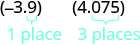 Place the decimal point 4 places from the right. 右端から4桁の位置に小数点を置く。 |
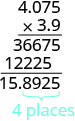 |
The signs are different, so the product is negative. 符号が異なるので、積は負になる。 |
(−3.9)(4.075) = −15.8925 |
Try It (2)確認問題(2題)
In many of your other classes, especially in the sciences, you will multiply decimals by powers of 10 (10, 100, 1000, etc.). If you multiply a few products on paper, you may notice a pattern relating the number of zeros in the power of 10 to number of decimal places we move the decimal point to the right to get the product.
英語のヒント
ほかの多くの授業、特に科学では、小数に10の累乗(10、100、1000など)を掛ける。いくつか紙に計算すると、10の累乗にあるゼロの数と、小数点を右に動かす桁数との規則に気付くだろう。
Example 1.99例題 1.99
Multiply 5.63 ⓐ by 10 ⓑ by 100 ⓒ by 1,000.
英語のヒント
5.63に、ⓐ 10、ⓑ 100、ⓒ 1,000を掛けよ。
Solution解答
By looking at the number of zeros in the multiple of ten, we see the number of places we need to move the decimal to the right.
英語のヒント
かける10の倍数に含まれるゼロの個数を見ると、小数点を右へ何桁動かすかが分かる。
ⓐ
5.63(10) |
|
There is 1 zero in 10, so move the decimal point 1 place to the right. 10にはゼロが1つあるので、小数点を右へ1桁動かす。 |
 |
ⓑ
5.63(100) |
|
There are 2 zeros in 100, so move the decimal point 2 places to the right. 100にはゼロが2つあるので、小数点を右へ2桁動かす。 |
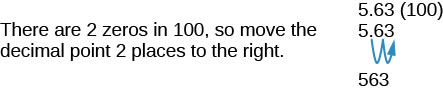 |
ⓒ
5.63(1,000) |
|
There are 3 zeros in 1,000, so move the decimal point 3 places to the right. 1,000にはゼロが三つあるので、小数点を右へ3桁動かす。 |
 |
A zero must be added at the end. 末尾にゼロを1つ加える必要がある。 |
 |
Try It (2)確認問題(2題)
Just as with multiplication, division of decimals is very much like dividing whole numbers. We just have to figure out where the decimal point must be placed.
英語のヒント
かけ算と同じく、小数のわり算も非負整数のわり算とよく似ている。小数点を置く位置を考えればよい。
To divide decimals, determine what power of 10 to multiply the denominator by to make it a whole number. Then multiply the numerator by that same power of Because of the equivalent fractions property, we haven’t changed the value of the fraction! The effect is to move the decimal points in the numerator and denominator the same number of places to the right. For example:
英語のヒント
小数を割るには、分母を非負整数にするために、10の何乗を掛ければよいかを決める。そして分子にも同じの累乗を掛ける。等しい分数の性質により、分数の値は変わらない。この操作は、分子と分母の小数点を同じ桁数だけ右へ動かすことに当たる。たとえば、次のようになる。
We use the rules for dividing positive and negative numbers with decimals, too. When dividing signed decimals, first determine the sign of the quotient and then divide as if the numbers were both positive. Finally, write the quotient with the appropriate sign.
英語のヒント
正負の数のわり算の規則は、小数にも使う。符号のある小数を割るときは、まず商の符号を決め、次に両方とも正の数であるかのように割る。最後に、適切な符号を付けて商を書く。
We review the notation and vocabulary for division:
英語のヒント
割り算の表記と用語を復習しよう。
We’ll write the steps to take when dividing decimals, for easy reference.
英語のヒント
参照しやすいように、小数の割り算の手順をまとめる。
Example 1.100例題 1.100
Divide:
英語のヒント
次の除法を計算する:
Solution解答
Remember, you can “move” the decimals in the divisor and dividend because of the Equivalent Fractions Property.
英語のヒント
等しい分数の性質によって、割る数と割られる数の小数点を「動かせる」ことを思い出そう。
The signs are the same. 符号は同じである。 |
The quotient is positive. 商は正である。 |
Make the divisor a whole number by “moving” the decimal point all the way to the right. 割る数の小数点を右端まで動かし、非負整数にする。 |
|
“Move” the decimal point in the dividend the same number of places. 割られる数の小数点を、同じ桁数だけ動かす。 |
 |
Divide. Place the decimal point in the quotient above the decimal point in the dividend. 割り算する。割られる数の小数点の真上に、商の小数点を置く。 |
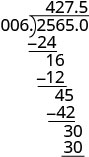 |
Write the quotient with the appropriate sign. 適切な符号を付けて商を書く。 |
Try It (2)確認問題(2題)
A common application of dividing whole numbers into decimals is when we want to find the price of one item that is sold as part of a multi-pack. For example, suppose a case of 24 water bottles costs $3.99. To find the price of one water bottle, we would divide $3.99 by 24. We show this division in Example 1.101. In calculations with money, we will round the answer to the nearest cent (hundredth).
英語のヒント
小数を非負整数で割る身近な場面に、まとめ売り商品の1個当たりの値段を求める場合がある。たとえば、水24本入り1ケースが3.99ドルなら、1本の値段は3.99ドルを24で割って求める。例題1.101でこの計算を示す。金額の計算では、答えを最も近い1セント、つまり小数第2位に四捨五入する。
Example 1.101例題 1.101
Divide:
英語のヒント
次の除法を計算する:
Solution解答
Place the decimal point in the quotient above the decimal point in the dividend. 割られる数の小数点の真上に、商の小数点を置く。 |
|
Divide as usual. When do we stop? Since this division involves money, we round it to the nearest cent (hundredth.) To do this, we must carry the division to the thousandths place. 通常どおり割る。どこで止めるか。金額の計算なので、最も近い1セント(小数第2位)に四捨五入する。そのために、小数第3位まで計算する。 |
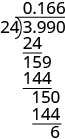 |
Round to the nearest cent. 最も近いセント単位に四捨五入する。 |