第1章基礎
1.4 Multiply and Divide Integers1.4 整数を掛ける・割る
Learning Objectives学習目標
Learning Objectives学習目標
By the end of this section, you will be able to:
英語のヒント
この節を終えると、次のことができるようになる。
- Multiply integers
英語のヒント
整数を掛ける - Divide integers
英語のヒント
整数を割る - Simplify expressions with integers
英語のヒント
整数を含む式を簡単にする - Evaluate variable expressions with integers
英語のヒント
整数を使って変数を含む式の値を求める - Translate English phrases to algebraic expressions
英語のヒント
英語の句を代数式に直す - Use integers in applications
英語のヒント
応用問題で整数を使う
Before You Begin学習の準備
Multiply Integers整数を掛ける
Since multiplication is mathematical shorthand for repeated addition, our model can easily be applied to show multiplication of integers. Let’s look at this concrete model to see what patterns we notice. We will use the same examples that we used for addition and subtraction. Here, we will use the model just to help us discover the pattern.
英語のヒント
掛け算は繰り返しの足し算を簡潔に表したものなので、コマのモデルを整数の乗法にも簡単に使える。この具体的なモデルを見て、どのような規則が見つかるか考えよう。加法と減法で使ったものと同じ例を使う。ここでは、規則を発見する助けとしてモデルを使う。
We remember that means add a, b times.
英語のヒント
は、aをb回足すことを意味する。
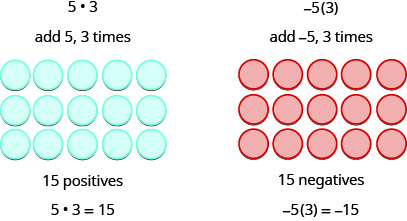
The next two examples are more interesting.
英語のヒント
次の二つの例は、さらに興味深い。
What does it mean to multiply 5 by It means subtract 5, 3 times. Looking at subtraction as “taking away,” it means to take away 5, 3 times. But there is nothing to take away, so we start by adding neutral pairs on the workspace. Then we take away 5 three times.
英語のヒント
5にを掛けるとは、どういう意味だろうか。5を3回引くという意味である。引き算を「取り去る」と考えると、5を3回取り去ることになる。しかし、取り去る物がないので、まず打ち消し合う組を作業面に置き、そこから5を3回取り去る。
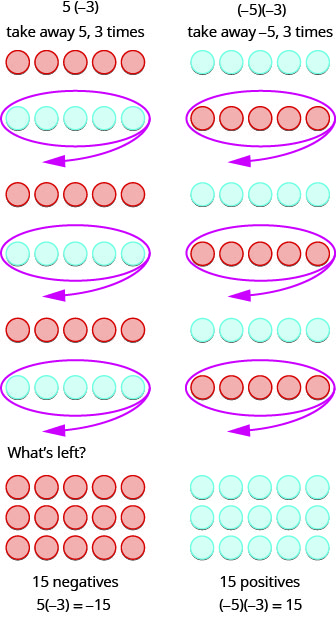
In summary:
英語のヒント
まとめると、次のようになる。
Notice that for multiplication of two signed numbers, when the:
英語のヒント
符号付きの二つの数の乗法では、次のことが分かる。
- signs are the same, the product is positive.
英語のヒント
符号が同じなら、積は正である。 - signs are different, the product is negative.
英語のヒント
符号が異なるなら、積は負である。
We’ll put this all together in the chart below.
英語のヒント
これらを下の表にまとめる。
Example 1.46例題 1.46
Multiply: ⓐ ⓑ ⓒ ⓓ
英語のヒント
掛け算せよ。ⓐ ⓑ ⓒ ⓓ
Solution解答
ⓐ Multiply, noting that the signs are different so the product is negative. ⓐ 掛ける。符号が異なるので、積は負になる。 |
|
ⓑ Multiply, noting that the signs are the same so the product is positive. ⓑ 掛ける。符号が同じなので、積は正になる。 |
|
ⓒ Multiply, with different signs. ⓒ 異なる符号の数を掛ける。 |
|
ⓓ Multiply, with same signs. ⓓ 同じ符号の数を掛ける。 |
Try It (2)確認問題(2題)
When we multiply a number by 1, the result is the same number. What happens when we multiply a number by Let’s multiply a positive number and then a negative number by to see what we get.
英語のヒント
ある数に1を掛けると、元と同じ数になる。では、を掛けるとどうなるだろうか。正の数と負の数に、それぞれを掛けて確かめよう。
Each time we multiply a number by we get its opposite!
英語のヒント
ある数にを掛けると、必ずその数の符号を逆にした数になる。
Example 1.47例題 1.47
Multiply: ⓐ ⓑ
英語のヒント
掛け算せよ。ⓐ ⓑ
Solution解答
ⓐ Multiply, noting that the signs are different so the product is negative. ⓐ 掛ける。符号が異なるので、積は負になる。 |
|
ⓑ Multiply, noting that the signs are the same so the product is positive. ⓑ 掛ける。符号が同じなので、積は正になる。 |
Try It (2)確認問題(2題)
Divide Integers整数を割る
What about division? Division is the inverse operation of multiplication. So, because In words, this expression says that 15 can be divided into three groups of five each because adding five three times gives 15. Look at some examples of multiplying integers, to figure out the rules for dividing integers.
英語のヒント
割り算はどうだろうか。除法は乗法の逆の演算である。なので、となる。言葉でいえば、5を3回足すと15になるので、15は5個ずつの組三つに分けられる。整数の乗法の例を使って、整数の除法の規則を考えよう。
Division follows the same rules as multiplication!
英語のヒント
除法も、乗法と同じ規則に従う。
For division of two signed numbers, when the:
英語のヒント
符号付きの二つの数の除法では、次のようになる。
- signs are the same, the quotient is positive.
英語のヒント
符号が同じなら、商は正である。 - signs are different, the quotient is negative.
英語のヒント
符号が異なるなら、商は負である。
And remember that we can always check the answer of a division problem by multiplying.
英語のヒント
割り算の答えは、掛け算でいつでも確認できることも思い出そう。
Example 1.48例題 1.48
Divide: ⓐ ⓑ
英語のヒント
割り算せよ。ⓐ ⓑ
Solution解答
ⓐ Divide. With different signs, the quotient is negative. ⓐ 割る。符号が異なるので、商は負になる。 |
|
ⓑ Divide. With signs that are the same, the quotient is positive. ⓑ 割る。符号が同じなので、商は正になる。 |